
A Ocrolus Alternative
Self-Serve Extraction, Validation & Export
Ocrolus is an enterprise document-automation platform for lenders and fintechs, combining OCR, machine learning and human review to analyse bank statements, pay stubs and tax documents for underwriting, income and cash-flow signals. FlowParse is the self-serve converter underneath that need: turn statements, pay stubs and invoices into clean, balance-validated, exportable data — with a REST API, per-page pricing and a free no-signup tier, no enterprise contract required.
Large lenders and fintechs that need an enterprise platform for underwriting analytics, income/cash-flow signals and fraud review at high volume, with a commercial contract.
Teams and individuals who need accurate, validated statement and document extraction with exports and an API — self-serve, affordable, with a free way to start.
Why Businesses Look for Ocrolus Alternatives
Self-serve, no enterprise contract
Sign up and convert a real statement today — no procurement cycle, minimums or sales-led onboarding.
Accounting-ready export
Ocrolus outputs data for analytics; FlowParse also gives you native .QBO/.QFX/.OFX and Xero/Excel files.
Balance validation in the box
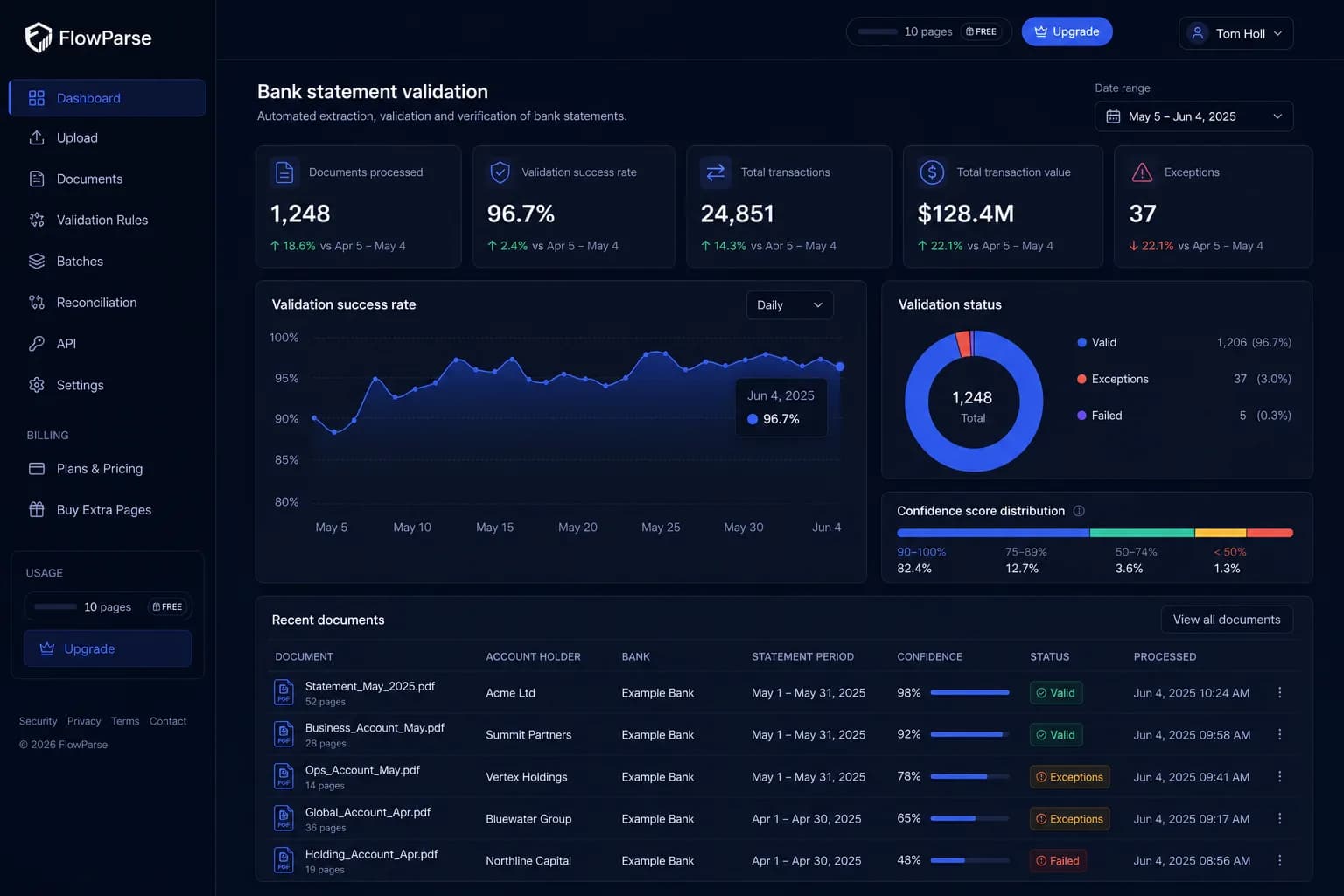
A deterministic check confirms opening + transactions = closing, with a 0–100 quality score.
Per-page pricing you can see
Pay per page from a balance with usage visible per key — not an annual enterprise quote.
Free to evaluate
Convert a statement, pay stub or invoice and see the output before paying anything.
Consolidate a year
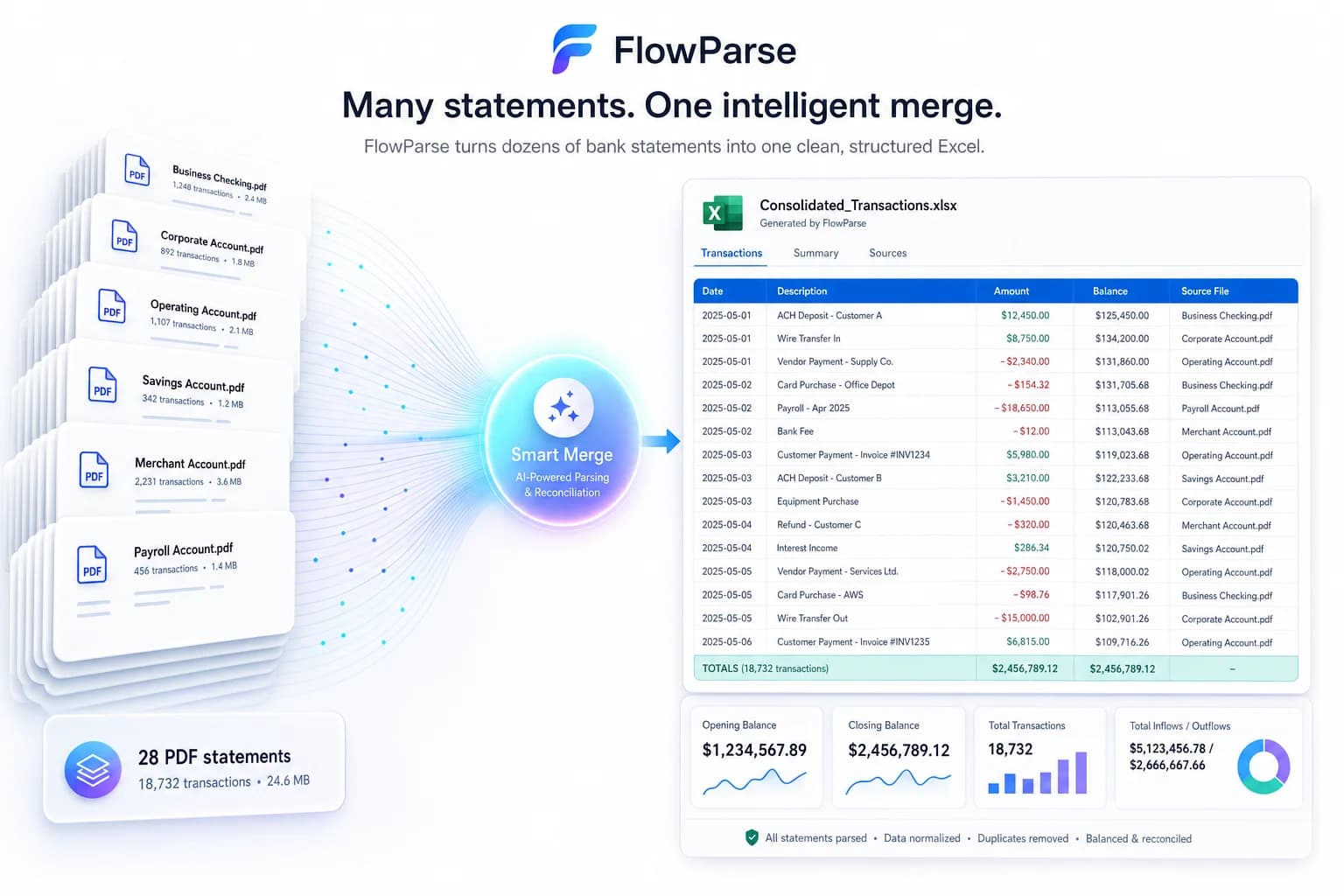
Smart Merge combines up to 100 statements into one reconciled Excel — a workflow, out of the box.
Quick Comparison — Ocrolus vs FlowParse
A feature-by-feature look at Ocrolus and FlowParse.
| Feature | Ocrolus | FlowParse |
|---|---|---|
| Bank statement PDF → structured data | Yes | Yes |
| Pay stub / income document extraction | Yes | Yes |
| Underwriting analytics & cash-flow signals | Yes | Clean input, not analytics |
| Native .QBO / .QFX / .OFX export | No | Yes |
| Xero / Excel / CSV export | Via API | Yes |
| Deterministic balance reconciliation + score | Detect-focused | Yes |
| Smart Merge — 100 PDFs → 1 Excel | No | Yes |
| Self-serve, no enterprise contract | No | Yes |
| Per-page pricing from a balance | Enterprise quote | Yes |
| Free no-signup tier | No | Yes |
| REST API | Yes | Yes |
| EU processing / GDPR focus | Enterprise terms | Yes |
What Is Ocrolus?
Ocrolus is an enterprise document-automation platform aimed at lenders, fintechs and financial institutions. It combines OCR, machine learning and a human-in-the-loop review layer to read bank statements, pay stubs and tax documents at high volume, and — crucially — to produce underwriting-grade analytics on top: cash-flow signals, income calculations, and detection of altered or inconsistent documents. It's sold as an enterprise platform with commercial onboarding.
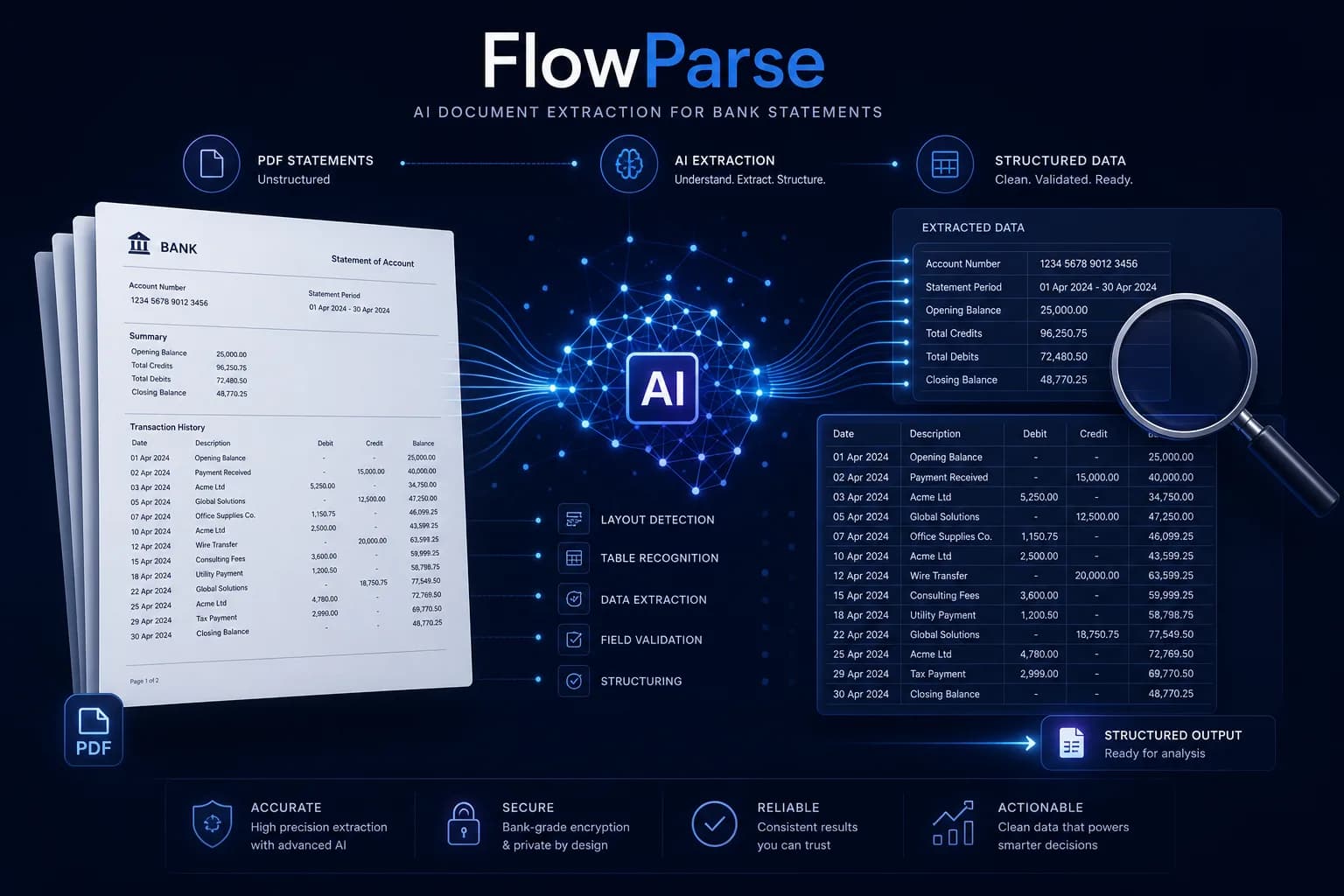
FlowParse is an AI document engine focused on converting financial documents — bank statements, pay stubs, invoices and receipts — into clean, validated, structured data and then into the files teams actually use. It produces the trustworthy extracted *input* a lending or finance workflow needs: every transaction, normalised and balance-validated, plus a quality score — available self-serve, with a REST API, per-page pricing and a free no-signup tier.
It's important to be honest about the difference: these aren't the same product. Ocrolus is a decisioning-support platform with analytics and fraud review built for enterprise lending; FlowParse is the accessible extraction-and-export layer beneath that. If you need a full underwriting-analytics platform with a contract, Ocrolus is built for that. If you need accurate, validated statement and income-document data — self-serve, exportable, affordable — FlowParse is the closer fit, and many teams build their own analysis on top of its clean output.
Ocrolus strengths
- Purpose-built for enterprise lending and underwriting at scale
- Analytics layer: cash-flow signals, income calculation, document review
- Human-in-the-loop review for high-stakes accuracy
- Established compliance posture for financial institutions
Where teams want something different
- Enterprise-only: contracts, minimums and sales-led onboarding
- No self-serve free tier to try a single document
- No native QBO/QFX/OFX accounting-export files
- Overkill (and over-priced) for teams that just need clean extracted data
Why Teams Switch to FlowParse
Start without a contract
Self-serve signup and a free tier — convert a real document today, no procurement.
Clean, validated input you control
Every transaction normalised and balance-validated with a 0–100 score, ready for your own analysis.
Accounting-ready export
Native .QBO/.QFX/.OFX (FITID de-dup) plus Xero/Excel/CSV, not just analytics output.
Transparent per-page cost
Pay from a top-up balance with usage visible per key — no annual enterprise quote.
Consolidate and reconcile
Merge a year of statements into one Excel and match payments to invoices, out of the box.
Build your own analysis on top
Get the trustworthy raw data over a simple REST API and apply your own underwriting logic.
Enterprise analytics platform vs self-serve extraction layer
Ocrolus delivers managed analytics and review for enterprise lending. FlowParse delivers the clean, validated, exportable data underneath — self-serve, so you build the analysis you need.
Enterprise-platform path
- Scope an enterprise contract
- Sales-led onboarding & minimums
- Managed HITL + analytics layer
- Underwriting signals returned
- Built for large-scale lending
FlowParse path
- Sign up free, no contract
- Upload a statement, pay stub or invoice
- AI extracts + validates (balance check)
- Export QBO/QFX/OFX/Xero/Excel or JSON
- Apply your own analysis on clean data
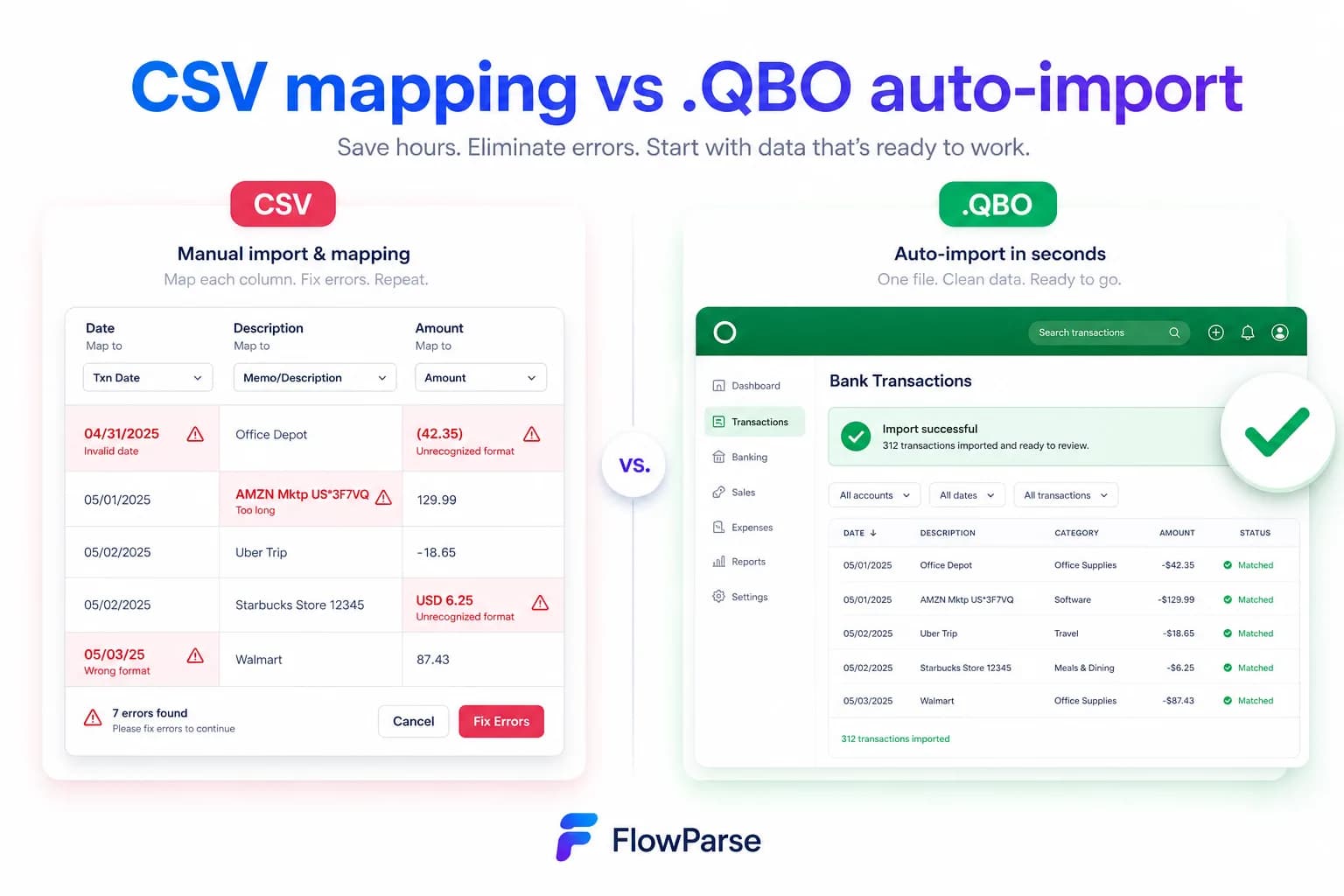
Pricing Comparison
How the cost and commitment models compare.
| Feature | Ocrolus | FlowParse |
|---|---|---|
| Free tier (no signup) | No | Yes — pages/month free |
| Model | Enterprise contract / quote | Per page from a balance |
| Minimum commitment | Typically yes | None |
| Accounting-export files | No | Yes (QBO/QFX/OFX/Xero) |
| Self-serve onboarding | Sales-led | Instant |
Accuracy Comparison
Both platforms use modern AI OCR — here is how extraction quality is assured.
| Feature | Ocrolus | FlowParse |
|---|---|---|
| Multi-page bank statements | Strong (HITL) | Every row, balance-validated |
| Pay stub / income fields | Strong | Strong |
| Balance reconciliation check | Detection-oriented | Deterministic pass/fail |
| Underwriting analytics | Built in | Out of scope — clean input only |
| Human review step | Managed HITL | Your editable grid + API |
Who should choose Ocrolus?
- Banks, lenders and fintechs underwriting at high volume
- Teams needing managed human-in-the-loop accuracy
- Workflows requiring built-in income and cash-flow analytics
- Institutions with enterprise procurement and compliance needs
Who should choose FlowParse?
- Brokers, smaller lenders and finance teams needing clean statement data
- Developers building their own income/cash-flow logic on extracted data
- Accountants and analysts converting statements and pay stubs
- Anyone wanting a free, self-serve way to convert a document
Migrating from Ocrolus to FlowParse
Switching takes minutes — there are no templates to rebuild or models to retrain.
Export your documents
Export invoices and statements from Ocrolus or your source.
Upload to FlowParse
Drag and drop PDFs, scans, or images — no setup.
Review extracted data
Check fields in the editable preview before export.
Export Excel or CSV
Download structured data for your accounting system.
Automate workflows
Use the API and integrations for future documents.
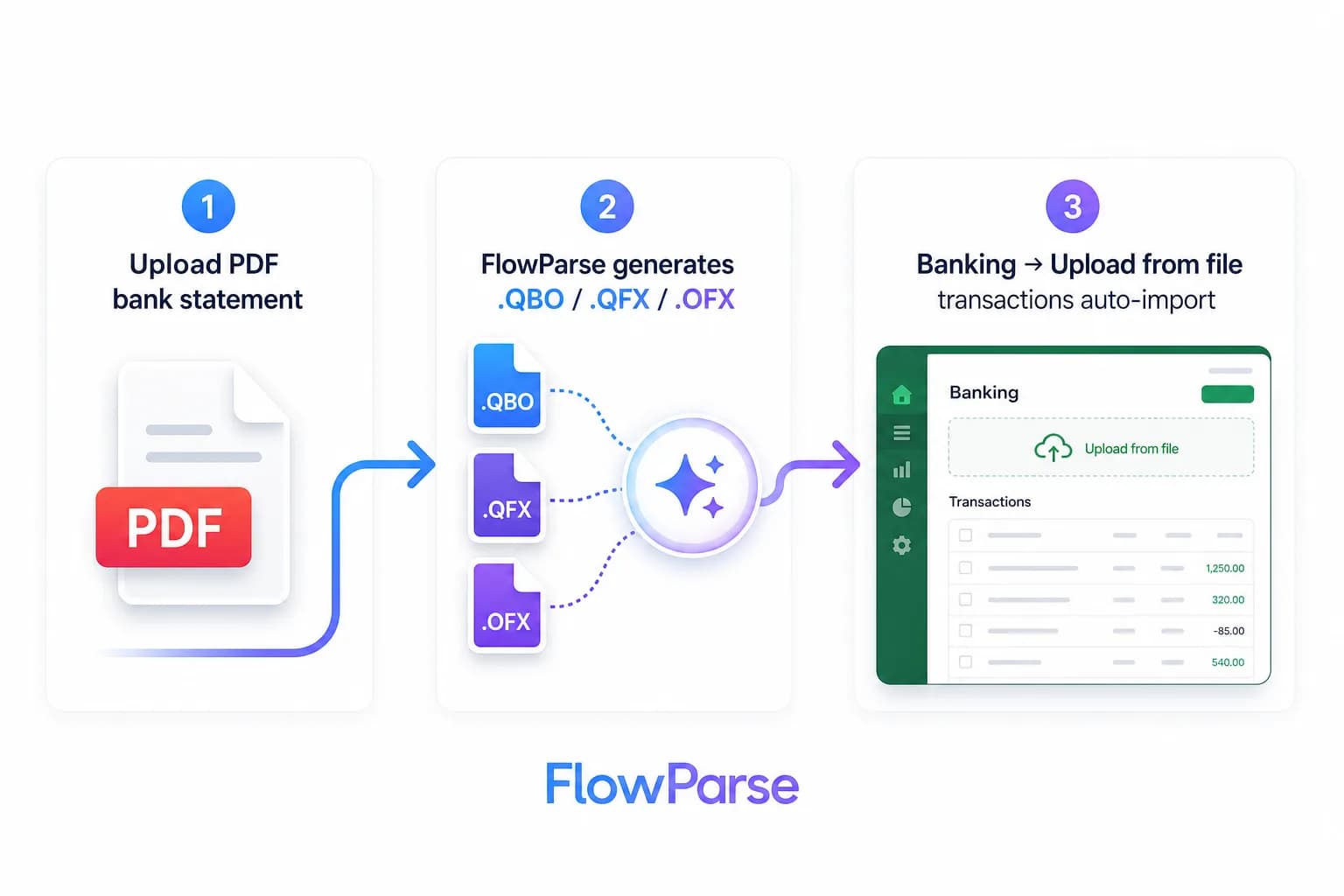
Ocrolus vs FlowParse: platform vs layer
The honest framing is that these tools sit at different altitudes. Ocrolus is an enterprise platform: it reads documents, applies managed human-in-the-loop review, and delivers underwriting-grade *analytics* — income calculations, cash-flow signals, document-integrity review — to lenders and fintechs that process huge volumes and need that decisioning support under a commercial contract. For that buyer, the analytics layer is the whole point.
FlowParse is the extraction-and-export *layer* beneath that need. It turns a statement, pay stub or invoice into clean, normalised, balance-validated data with a quality score, and hands it to you over an API or as a file — self-serve, per page, with a free tier. It deliberately stops short of making lending decisions; instead it gives you trustworthy income and deposit input so you can apply your own logic.
So the deciding question is whether you're buying a platform or a layer. If you need managed analytics and review at enterprise scale, Ocrolus is built for that. If you need accurate, validated, exportable data — and the freedom to build your own analysis without a contract — FlowParse is the closer, lighter, cheaper fit.
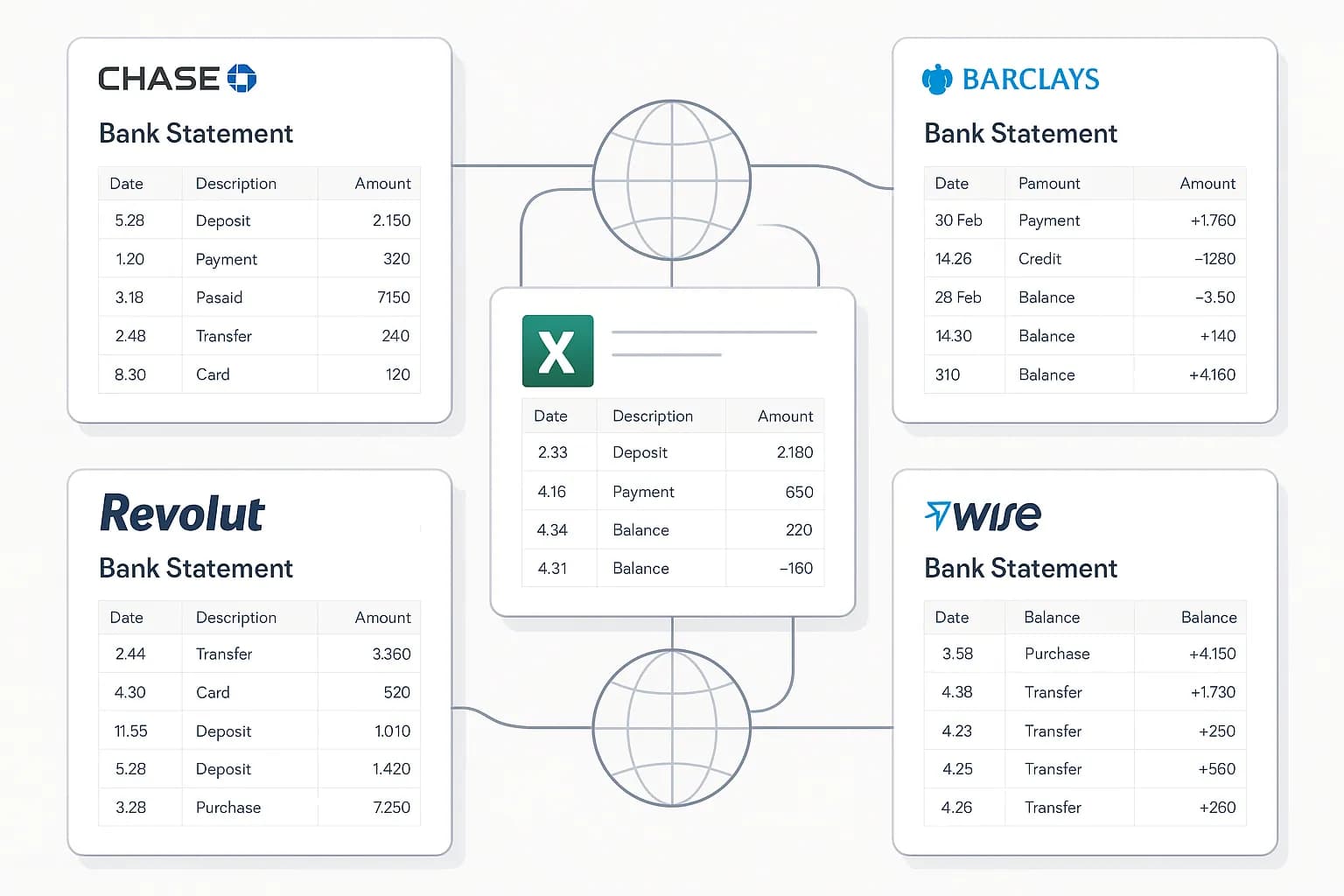
Clean input, not a black-box decision
A lot of lending pain comes from not trusting the data underneath the decision. FlowParse focuses entirely on making that data trustworthy: every transaction is extracted and normalised to a single signed amount, recurring deposits and average monthly income can be surfaced, and a deterministic balance-reconciliation check proves opening balance plus transactions equals closing balance. The output is auditable input, not an opaque score.
That matters because it keeps the decision — and the compliance responsibility — with you. FlowParse won't tell you whether to approve a loan; it tells you, provably, what the statements say. For teams that want to own their underwriting model, that's a feature, not a gap: you get the same quality of extracted data an analytics platform starts from, then apply exactly the logic your risk and compliance teams have signed off.
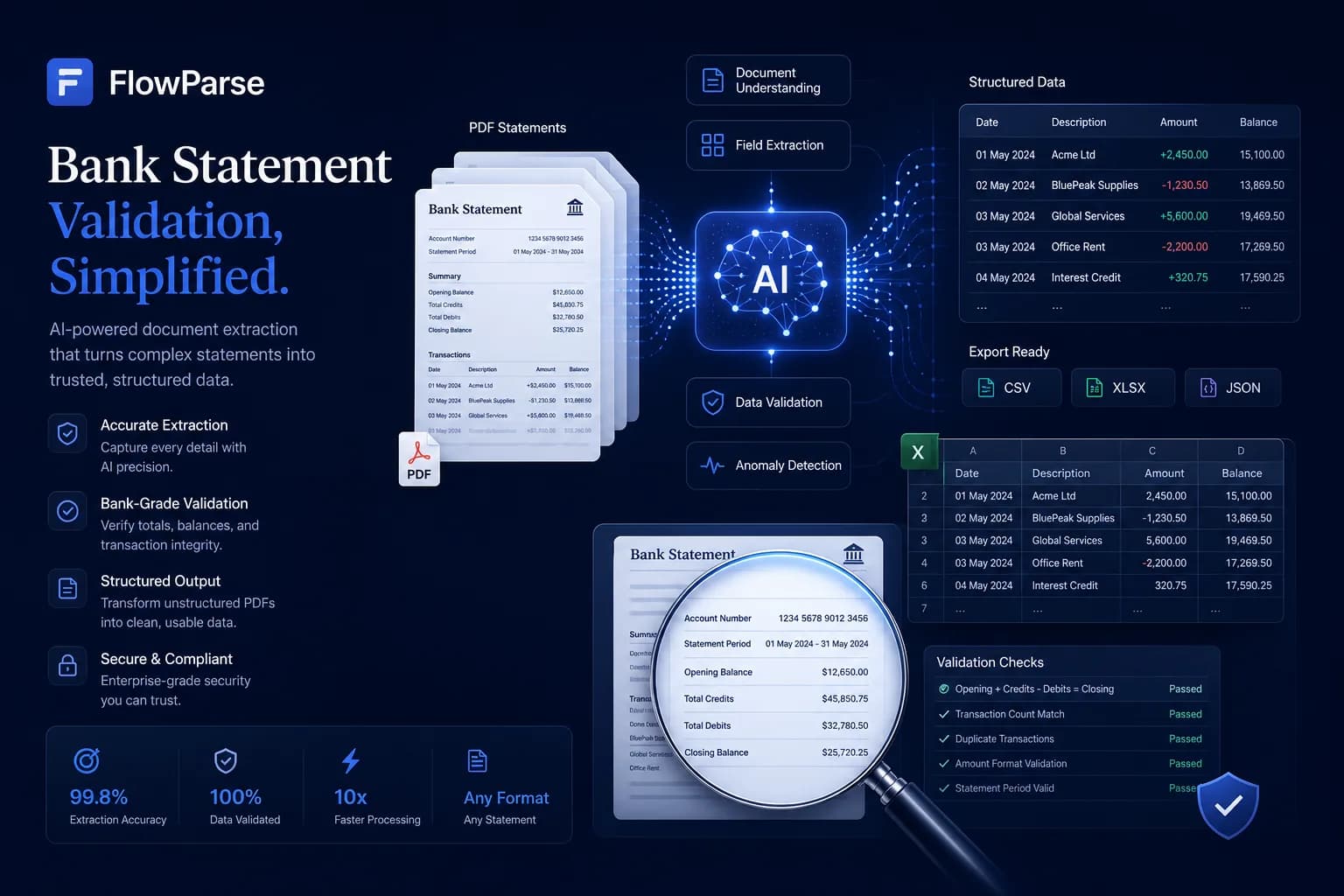
Accounting and analysis export
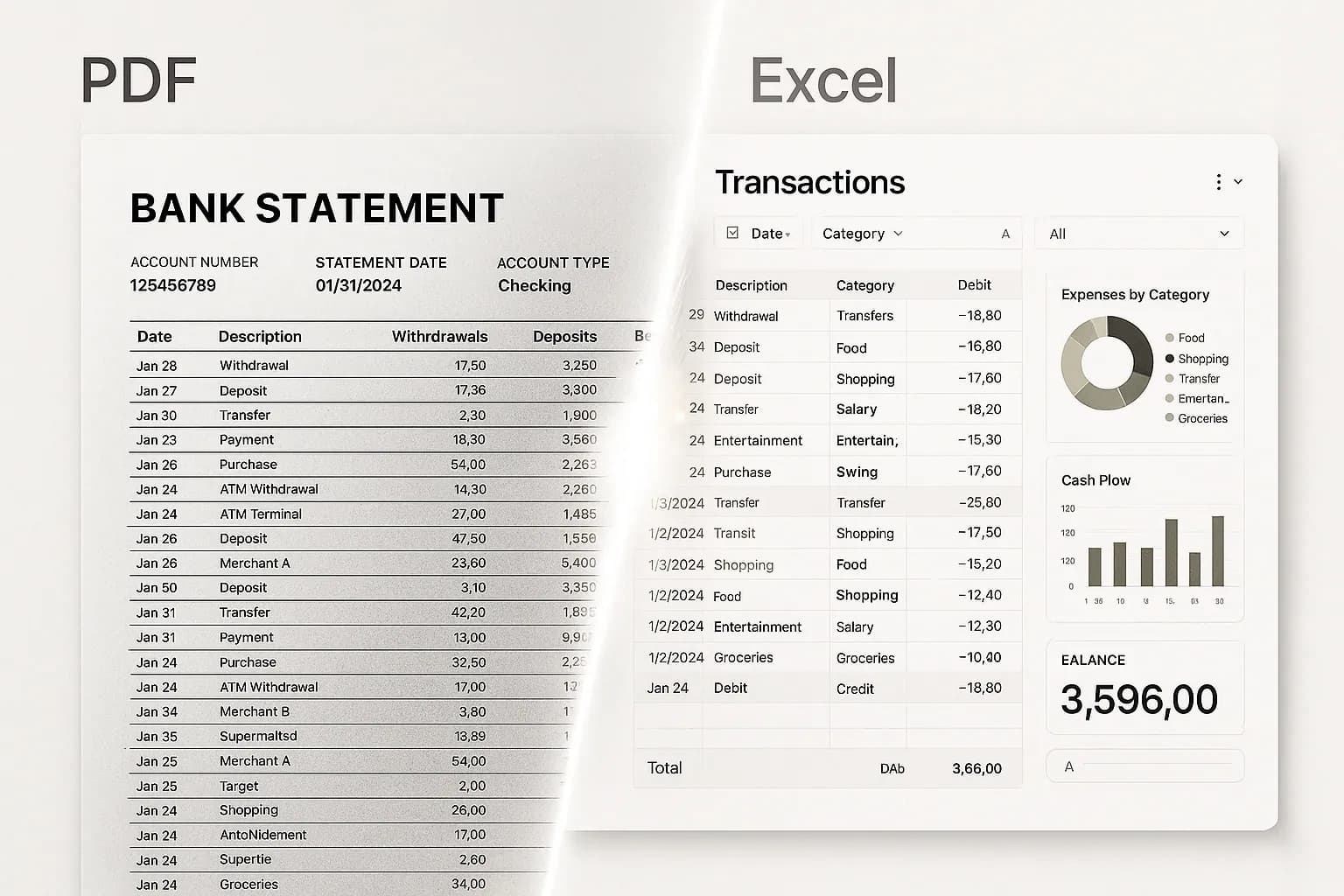
Ocrolus returns data for analytics consumption. FlowParse returns both raw structured data *and* the files downstream tools import. For developers that's clean JSON over the document extraction API; for finance teams it's real Open Financial Exchange files — `.QBO` and `.QFX` for QuickBooks and Quicken, `.OFX` for GnuCash and Sage — plus Xero CSV and Excel, each transaction carrying a stable `FITID` so a re-import never double-posts.
This dual output widens who can use it. A broker can hand an accountant a QBO bank feed; a fintech can pull JSON over the API; an analyst can drop a year into Excel via Smart Merge. The accounting export feature shows the full format list and import steps.
| Output | Ocrolus | FlowParse |
|---|---|---|
| Structured JSON via API | Yes | Yes |
| .QBO / .QFX / .OFX files | No | Native |
| Xero CSV / Excel | No | Native |
| Underwriting analytics | Built in | Out of scope (clean input) |
| FITID de-duplication | N/A | Built in |
Self-serve workflow and API
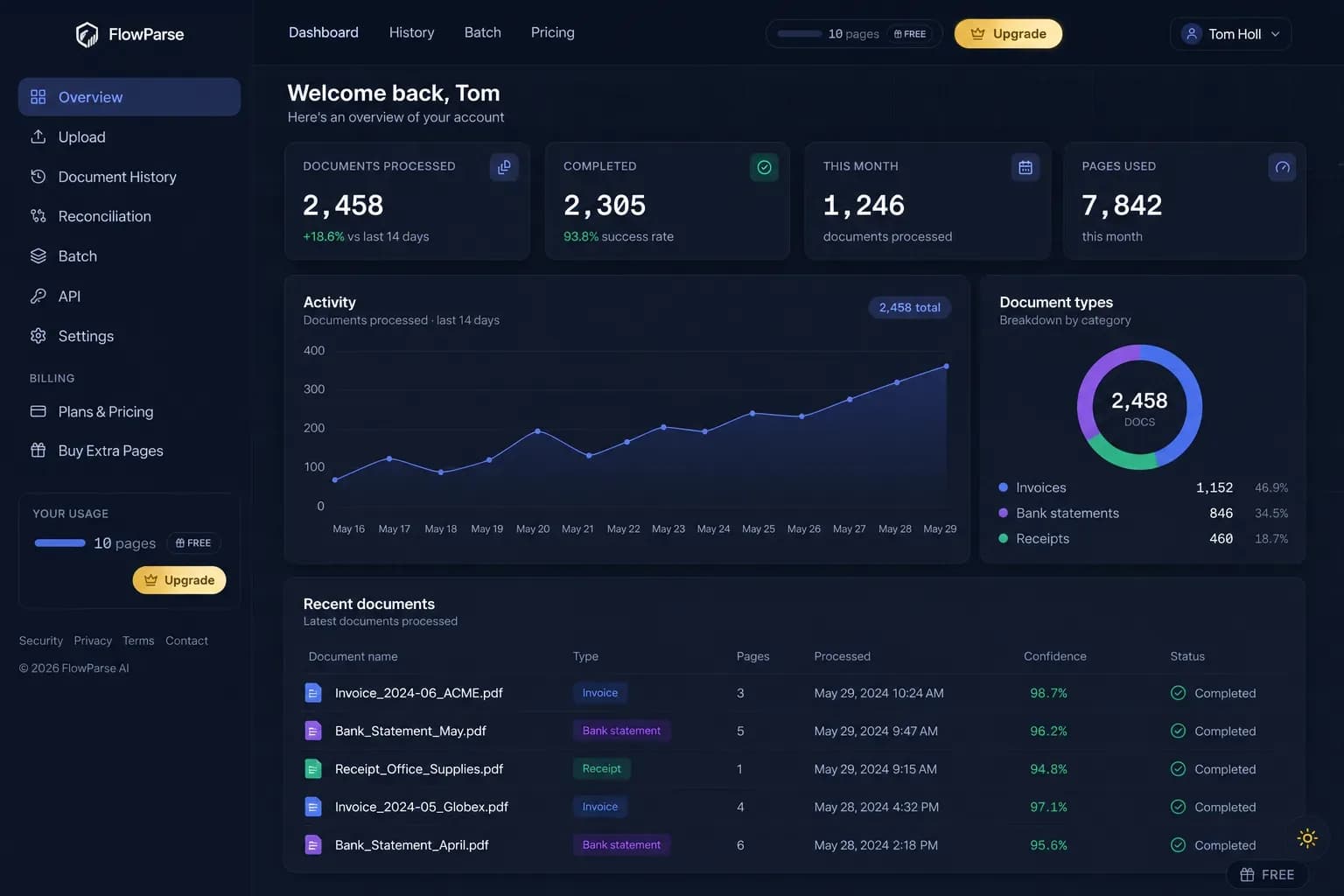
Ocrolus is, by design, an enterprise engagement. FlowParse gives you both a self-serve browser workflow and an API with no contract in the way: anyone can upload a statement, review and fix any row in an editable grid, run reconciliation, and export — and a developer can do the same over REST, billed per page. There's no minimum and no sales call.
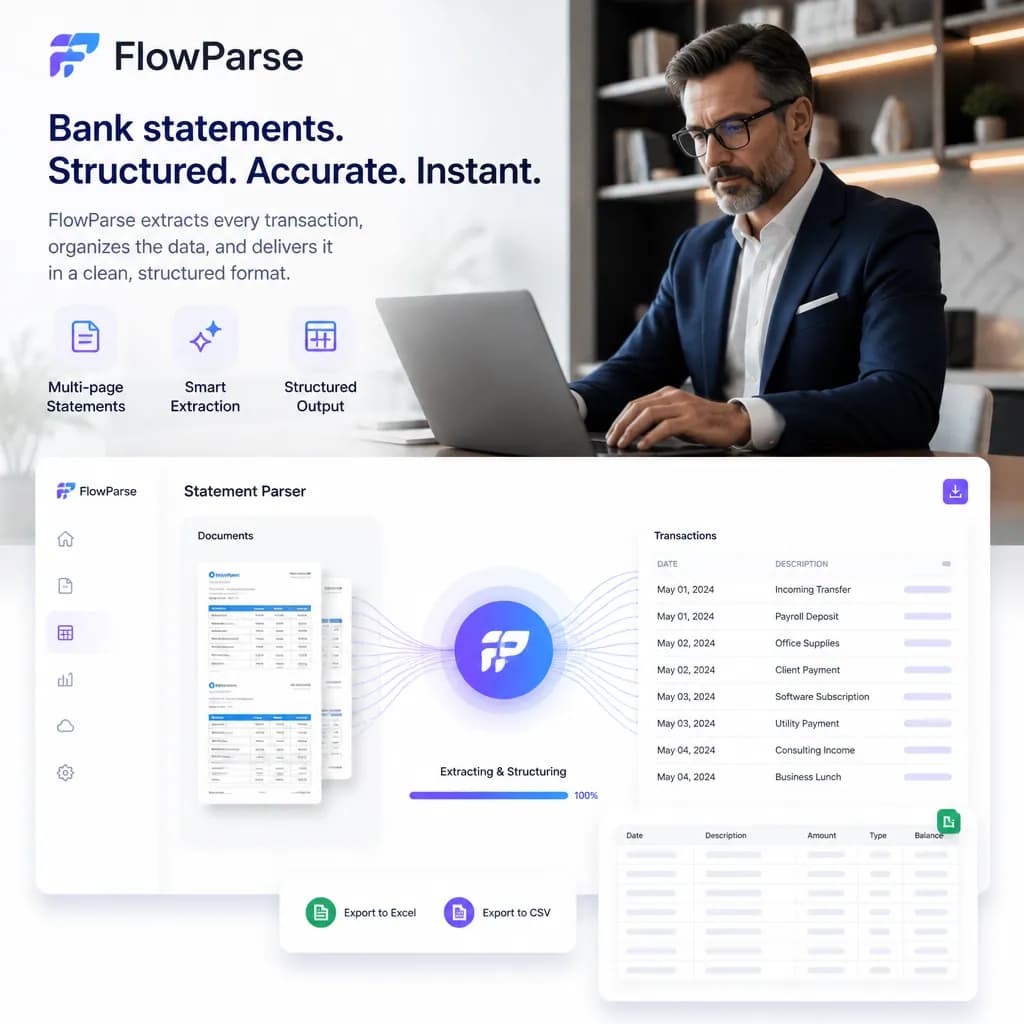
That lowers the cost of evaluation to almost nothing. Instead of scoping an enterprise pilot to find out whether extraction is accurate enough, you can drop a real statement into the bank statement to Excel tool and judge the output in seconds. When you're ready to automate, the same capabilities are available through the bank statement API and document extraction API, with the parsing guide covering the integration pattern.
Pricing, privacy and getting started
FlowParse pricing is per page drawn from a balance, with a free monthly allowance and no signup required to try it — usage is visible per API key so cost is predictable and attributable, with no minimums or annual commitment. That contrasts sharply with an enterprise quote, where evaluating the product means a procurement process first. See the pricing page for plans.
On privacy, FlowParse processes in EU data centres, deletes the original PDF immediately after extraction, stores extracted data encrypted, and never trains models on your documents — details on the security page. Getting started is the easiest part: convert a document free in the app, then, when you want to automate, get an API key and integrate.
More than statements: pay stubs, invoices and reconciliation
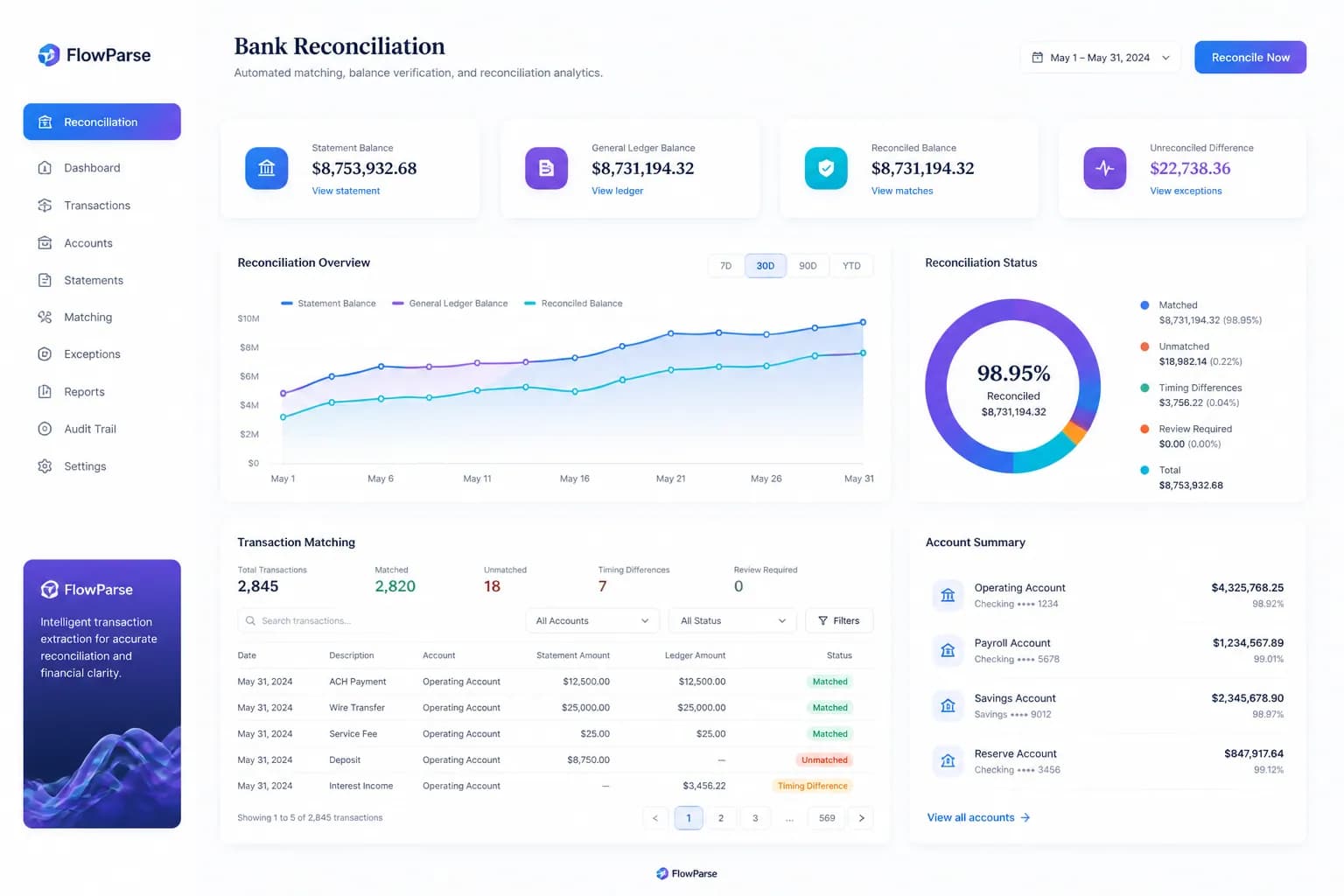
Lending and finance workflows rarely involve statements alone. FlowParse extracts pay stubs and income documents, invoices and receipts with full line items, and runs an AI VAT auditor on invoices — so the same engine that pulls transactions from a bank statement also gives you the proof-of-income and supporting documents in the same shape.
Because everything comes back in a consistent schema, cross-checks become straightforward: compare the income on a pay stub against recurring deposits on a statement, or reconcile an invoice against the bank payment. An enterprise platform does this inside its own analytics; FlowParse gives you the validated pieces so you can do it inside your own system, exactly the way your process requires.
That composability is the point of a layer rather than a platform: you assemble the workflow you need from trustworthy, validated parts, instead of buying — and paying for — a fixed analytics product you may only partly use.
Security, compliance and data residency
Financial-document tools live or die on trust, and lending data is as sensitive as it gets. FlowParse processes documents in EU data centres, deletes the original PDF the moment extraction completes, stores only the extracted data (encrypted), lets you delete it at any time, and never uses your documents to train models — detailed on the security page. For EU-centric teams that data-residency and deletion default is often decisive.
On access control, each API key is hashed, scoped to your account, request-counted and instantly revocable, and every call is logged with a document label and page cost for a clean audit trail. You decide retention because you control the request: store the fields you need, drop the `raw_table` if you don't, and keep applicant PII out of your logs. That combination of strong defaults and your own control is designed to satisfy both a developer and a compliance reviewer.
| Aspect | Detail |
|---|---|
| Processing region | EU data centres |
| Original PDF | Deleted after extraction |
| Model training | Never on your documents |
| API keys | Hashed, scoped, revocable, logged |
| Your data | Encrypted; delete anytime; standard-format export |
A real-world scenario: a mortgage broker
Picture a small mortgage broker, not a national lender. Each application brings three months of bank statements from a couple of banks and a few pay stubs. An enterprise analytics platform would solve the problem comprehensively — and price the broker out, with a contract and minimums sized for institutions that process thousands of files a day. The broker needs the *input* that platform starts from, not the whole platform.
With FlowParse, the broker uploads each statement, gets every transaction back balance-validated, surfaces recurring income deposits, and pulls the pay-stub figures in the same shape — then exports a clean Excel summary for the file. Cost is a few pages per application from a top-up balance; there's no contract and nothing to procure. The broker applies the lender's affordability rules themselves, keeping the decision and the compliance squarely in-house.
Scale that pattern up and it still holds for a regional lender or a fintech that wants to own its underwriting model: take the validated extraction layer, skip the fixed analytics product, and build exactly the logic your risk team requires on top. The lesson is that not every team that reads bank statements needs an enterprise decisioning platform — many just need the clean, trustworthy data underneath it, available without a contract.
The middle market: too big for a spreadsheet, too small for an enterprise platform
There's a wide band of teams that an enterprise platform doesn't serve well and a manual spreadsheet no longer serves at all: the growing broker, the regional lender, the fintech at its first scale step, the analyst pulling statements for a portfolio. They process enough documents that copying transactions by hand is untenable, but not the institutional volume that justifies an enterprise contract, minimums and a managed-review layer. That middle market is exactly who FlowParse is built for.
What that band actually needs is the trustworthy *input* an analytics platform starts from — every transaction extracted, normalised and balance-validated, with a quality score and recurring income signals surfaced — delivered self-serve, per page, over a simple API. They then apply their own logic, which is usually a deliberate choice rather than a limitation: a growing lender often wants to own and iterate its underwriting model, not outsource it to a fixed product.
The economics fit the stage, too. Per-page pricing from a balance scales smoothly with volume and needs no procurement, so a team can start on a handful of applications and grow into thousands without renegotiating a contract. If it ever does reach genuine enterprise scale with a need for managed human-in-the-loop review and built-in analytics, an enterprise platform becomes the right tool — but most teams reading statements never cross that line, and shouldn't pay as though they will.