
 Excel · CSV · QBO · Xero
AIB Statement to Excel Converter
AIB keeps eStatements for up to seven years — for bank account statements issued since 30 November 2011 and credit card statements issued since 21 October 2014 — in Internet Banking and the AIB Mobile Banking App, free and as PDFs you can save to your own computer. Customers with eligible accounts don't even need to register: the eStatements are simply there.
Scanned or digital · multi-page · balance-validated · duplicates removed

From a AIB PDF to a working spreadsheet
A fictional sample document converted by the same engine you get — flip through the source PDF and every export format, or download the files themselves.
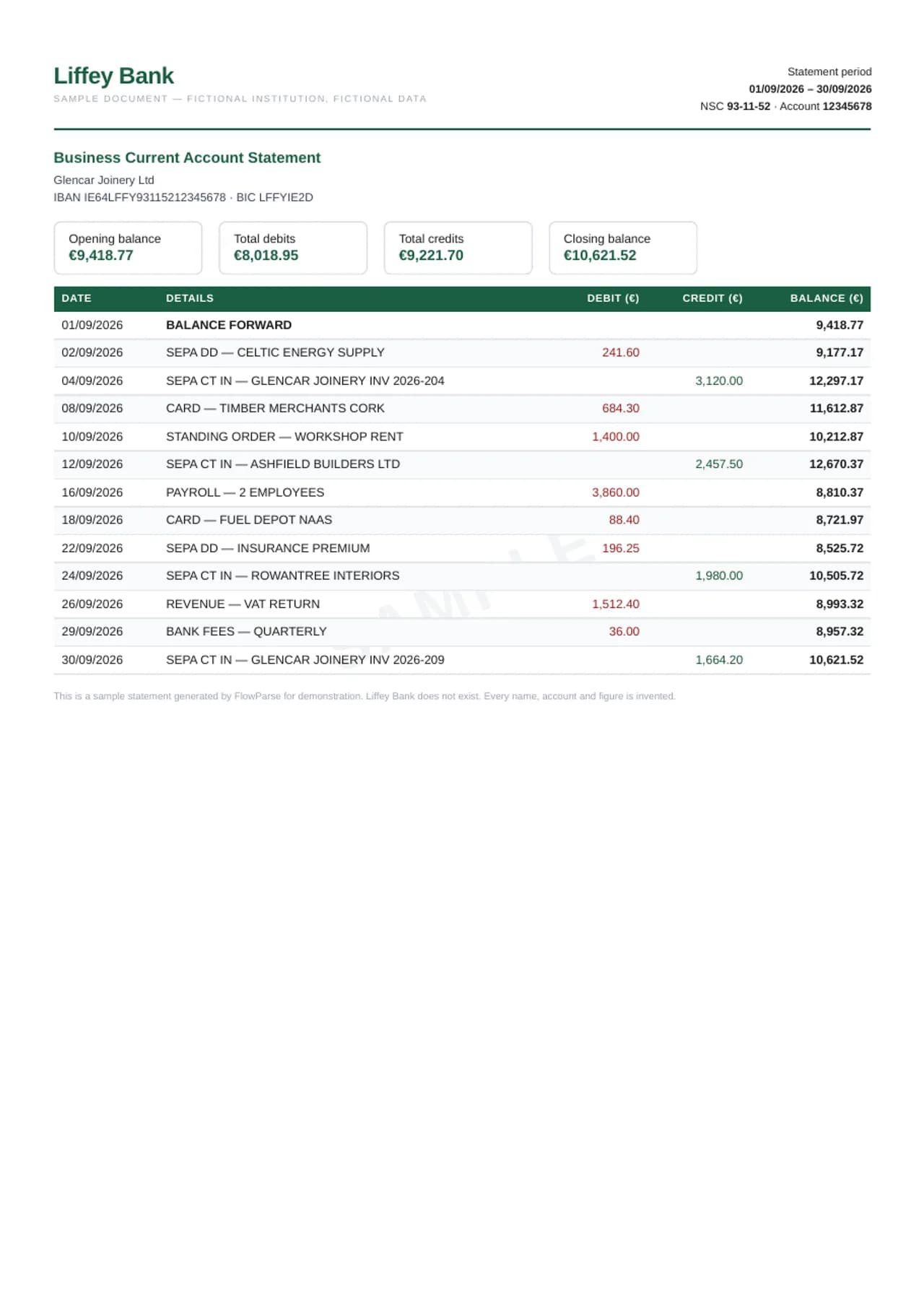
FlowParse turns an AIB eStatement into rows: the date, the details with the payee, direct debit originator or transfer reference, and the amount in euros with its sign — debits negative, credits positive, from the column they are printed in. The opening balance plus every transaction is checked against the closing balance, and the result exports to Excel, CSV, or a file for Xero, Sage, QuickBooks or any other accounting software.
AI extraction, no templates
Reads this bank's layout with no per-bank setup.
Every column preserved
Date, description, amount, balance and every extra field, 1:1.
Balance-validated
Opening + transactions = closing, checked on every file.
Scanned & multi-page
OCR for image PDFs; long statements stitched into one list.
Seven years — with two dates that matter
AIB's eStatement guide sets out the archive in three lines. From 30 November 2011, every newly issued bank account eStatement is viewable for up to seven years. Bank account eStatements issued before that date were kept for a maximum of two years. And from 28 October 2015, credit card eStatements issued from 21 October 2014 onwards are viewable for up to seven years.
Seven years of monthly statements is up to 84 PDFs per account, all available without asking the bank. Download the ones you need, upload them together, and FlowParse turns them into one proved table.
| Field | Captured in the export |
|---|---|
| Date | Transaction / posting date, normalised |
| Description | Payee, merchant or transfer detail, verbatim |
| Amount | Single signed value (debits −, credits +) |
| Balance | Running balance per transaction |
| Reference / type | Check number, transaction type, reference |
No registration for eligible accounts
AIB says customers with eligible accounts can see eStatements online without registering for the service, and can choose to stop paper statements on those accounts from Internet Banking. Statements arrive as PDFs that can be saved locally, which AIB itself suggests if you want to keep a file of your banking records at home.
A saved PDF is also the most reliable input for conversion: it carries the statement's real text, so every figure FlowParse reads is the figure AIB printed.
New to this? Read the guide on how to convert a bank statement PDF to Excel.
Account and credit card eStatements
AIB issues eStatements for personal current and savings accounts and for credit cards, with their own start dates for the seven-year window. A current account statement lists transactions between an opening and a closing balance; a credit card statement lists purchases, refunds and payments between the previous and the new balance.
FlowParse converts both. Merged, the card payment on the current account statement sits next to the payment received on the card statement — the pair a bookkeeper needs to see to avoid counting the same money twice.
Older than November 2011
Bank account eStatements issued before 30 November 2011 were only kept online for two years, so anything from that period that you still need has to come from your own records or from a request to AIB. Old paper statements from a drawer can be scanned and converted through OCR; scan them flat, one statement per file.
Each scanned statement is proved against its printed balances just like an eStatement, which is what catches a misread digit on a faded page.
A tax year in one workbook
For a Form 11 return, a landlord's rental accounts, a sole trader's year end, a mortgage application or a probate, Smart Merge takes up to 100 AIB PDFs — current account, savings, credit card — and builds one workbook with every transaction in date order, the account and source on every row, and a check that each closing balance is the next opening balance.
Statements from Bank of Ireland or PTSB can be merged into the same workbook, matched column by column.
AIB to Xero, Sage or QuickBooks
Irish accountants and small businesses commonly work in Xero, Sage, QuickBooks or Surf Accounts. FlowParse exports a CSV with date, details and signed amount for a bank import, a QBO file for QuickBooks, and an Excel file for review first.
Because the details are kept whole — the direct debit originator, the transfer reference — each line can be matched to an invoice or receipt after import.
Mortgage applications
Irish mortgage lenders ask for several months of current account statements, and often credit card and savings statements too, to check income, regular commitments and savings. Applicants usually send the PDFs; brokers and underwriters then read them line by line.
Converted, the same PDFs become a sheet that can be filtered: the salary credits, the rent or existing loan payments, the regular savings transfers. The proof shows each statement adds up to AIB's own balances, and the chain shows no month is missing.
Where hand-copied statements go wrong
Debits and credits are unsigned columns; pasted into one list they all become positive. An Irish date like 03/04/2025 is the 3rd of April, and an American-default spreadsheet turns it into March 4th. Long details — a SEPA credit with a reference, a card payment abroad with its currency conversion — wrap over two lines and become two rows.
FlowParse signs by column, writes unambiguous dates and keeps one transaction per row; the balance proof confirms nothing was split or dropped.
Example: a landlord's rental accounts
A landlord with one rental property keeps the rent and expenses in an AIB current account and pays repairs by AIB credit card. Their accountant needs the calendar year for the rental income on the tax return. The figures here are an illustration, not a real landlord's.
The landlord downloads twelve current account and twelve credit card eStatements and uploads all 24. FlowParse returns one workbook, each statement proved, both accounts chained. Filtering the details shows the twelve rent credits, the mortgage interest, the insurance direct debit and the repairs on the card; the card repayment is matched on both sides. The accountant gets a CSV and the PDFs instead of a pile of printouts.
Before you rely on converted AIB statements
Coverage: each closing balance equal to the next opening balance, per account. Pairs: card repayments matched between the current account and the card statement. Reconciled: every statement proved before its totals are used.
And keep the PDFs. The converted file is a working copy; the eStatement is the record for Revenue, a lender or a solicitor.
Which AIB documents convert
Current account, savings account and credit card eStatements list transactions between two balances and convert the same way. Scanned paper statements convert through OCR.
Annual interest certificates, fee notices and letters are single figures or notices. Keep them with the file; convert the statements.
Probate and an executor's first weeks
An executor handling a parent's estate needs to know what came in and went out of the accounts: pensions credited, direct debits still running, transfers made in the last months. AIB statements, saved as PDFs or requested from the bank, are where that story is told — but reading years of them one page at a time is slow.
Converted and merged, the statements become one sheet in date order, each one proved against its balances. Filtering by originator lists the direct debits to cancel; sorting by amount shows the large payments the solicitor will ask about.
Turning off paper — and keeping a file at home
AIB lets you stop paper statements on eligible accounts and manage statement settings in Internet Banking. Its guide makes the point that you no longer have to store and dispose of paper statements safely, and that because eStatements are PDFs, you can save them locally if you want to keep a file of your banking records at home.
That home file is what FlowParse works from. Save each month's PDF into one folder per account and year as it arrives, and the seven-year window stops mattering: whatever AIB removes from Internet Banking, you still have. Converting the folder at year end then takes one upload instead of an evening of retyping, and every statement in it is proved against AIB's own balances.
From PDF to clean data in three steps
1 · Upload the PDF
Drop one statement or many — digital or scanned, any number of pages.
2 · AI extracts & validates
Every transaction is read, amounts signed, balances checked, weak pages retried.
3 · Review & export
Check the editable preview, then download Excel, CSV, QBO, QFX, OFX or Xero.
For AIB the PDF is usually an eStatement from Internet Banking or the AIB Mobile Banking App.
Convert to the format you need
The same extraction powers every export — convert once, then choose the output your next tool expects.
AIB keeps up to seven years of eStatements as PDFs; FlowParse turns them into rows.
| Format | Best for |
|---|---|
| Excel (.xlsx) | Analysis, totals, sharing |
| CSV | Importing into any tool |
| .QBO | QuickBooks Online & Desktop |
| .QFX | Quicken |
| .OFX | Most accounting tools |
| Xero CSV | Xero statement import |
Manual work vs FlowParse
Re-typing a statement by hand is slow and error-prone. FlowParse is near-instant, accurate, and scales to any volume.
By hand, an AIB PDF loses its sign — debits and credits become one list of positive numbers.
| What happens | By hand | FlowParse |
|---|---|---|
| Reading the data | Copy-paste line by line | AI extracts every transaction |
| Scanned statements | Re-typed manually | OCR reads them automatically |
| Debits & credits | You fix every sign | Pre-signed, normalised |
| Balance check | Manual reconciliation | Validated automatically |
| Time per statement | 20–40 minutes | Under a minute |
| A full year | Hours per account | One Smart Merge upload |
A whole year into one reconciled Excel
The opening balance plus every signed transaction must equal the closing balance. FlowParse checks that on every AIB statement, and checks each row against the running balance where it is printed. A credit read as a debit, or a line lost where a page breaks, fails at the row where it happened.
Statements that pass are marked reconciled; anything else is shown in the preview with the difference and the rows around it.
Import straight into your accounting software
Need it in your books? FlowParse builds a real bank-feed file. The .QBO imports directly into QuickBooks with no CSV column mapping, each transaction carries a unique ID so re-imports never duplicate, and Quicken users get .QFX.
In Ireland that usually means Xero, Sage, QuickBooks or Surf Accounts.
Validated, not just converted
An AIB statement gives the account name, the IBAN and BIC, the statement date and the opening balance, then the transactions: date, details — a direct debit with the originator, a standing order, a SEPA credit transfer, a card payment, an ATM withdrawal, a fee — and the amount in a debit or credit column, with the balance. The closing balance ends it.
FlowParse writes one row per transaction with the date, the full details and one signed amount in EUR, decided by the column, so the amount column sums to the change in balance.
More on the validation and reconciliation engines.
Your bank statements stay private
Bank statements are among the most sensitive documents you own. Converting one never puts it at risk.
Your AIB PDF is deleted automatically 30 days after upload.
Encrypted transfer
Every upload and download runs over TLS.
Auto-deleted in 30 days
Your original PDF is removed automatically 30 days after upload.
EU servers
Stored on servers in the EU.
No AI training
Your documents are never used to train models. GDPR-aligned.
Read the full security overview.
Who converts these statements
Irish accountants, landlords and sole traders, mortgage applicants, and executors handling an estate.
Accountants
Bring client statements into Excel or QuickBooks without re-keying.
Bookkeepers
Catch up months of statements in minutes.
Small businesses
Get PDF-only statements into the books, ready for tax time.
Loan & mortgage applicants
Turn statements into a clean spreadsheet for underwriting.
Finance teams
Standardise statements from many banks into one format.
Anyone with a PDF statement
Skip the manual typing — convert and move on.
Explore the bank statement toolkit
For other Irish banks, see the Bank of Ireland and PTSB converters.