

A Hyperscience Alternative
Finished Financial Extraction, Self-Serve And Priced Per Page
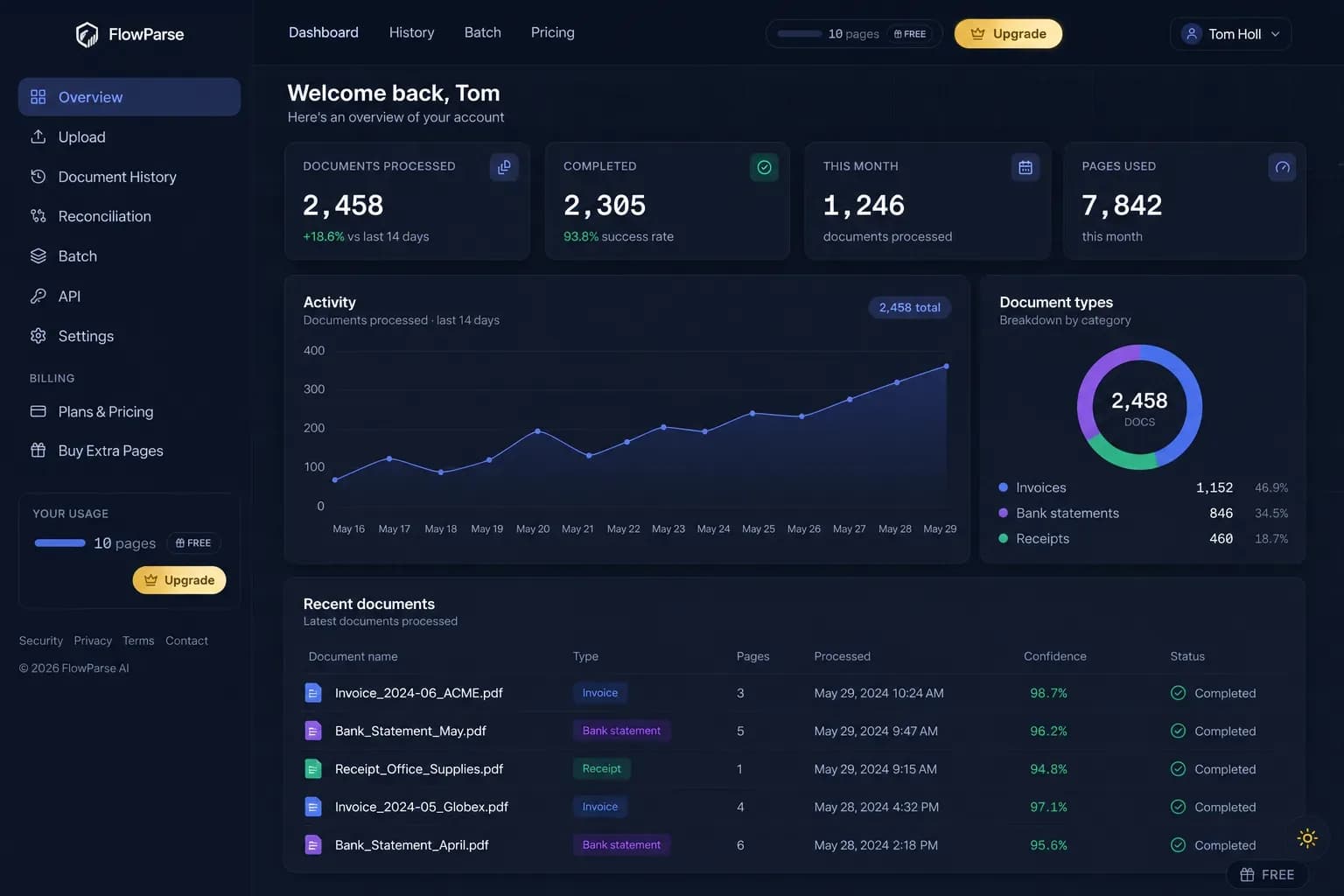
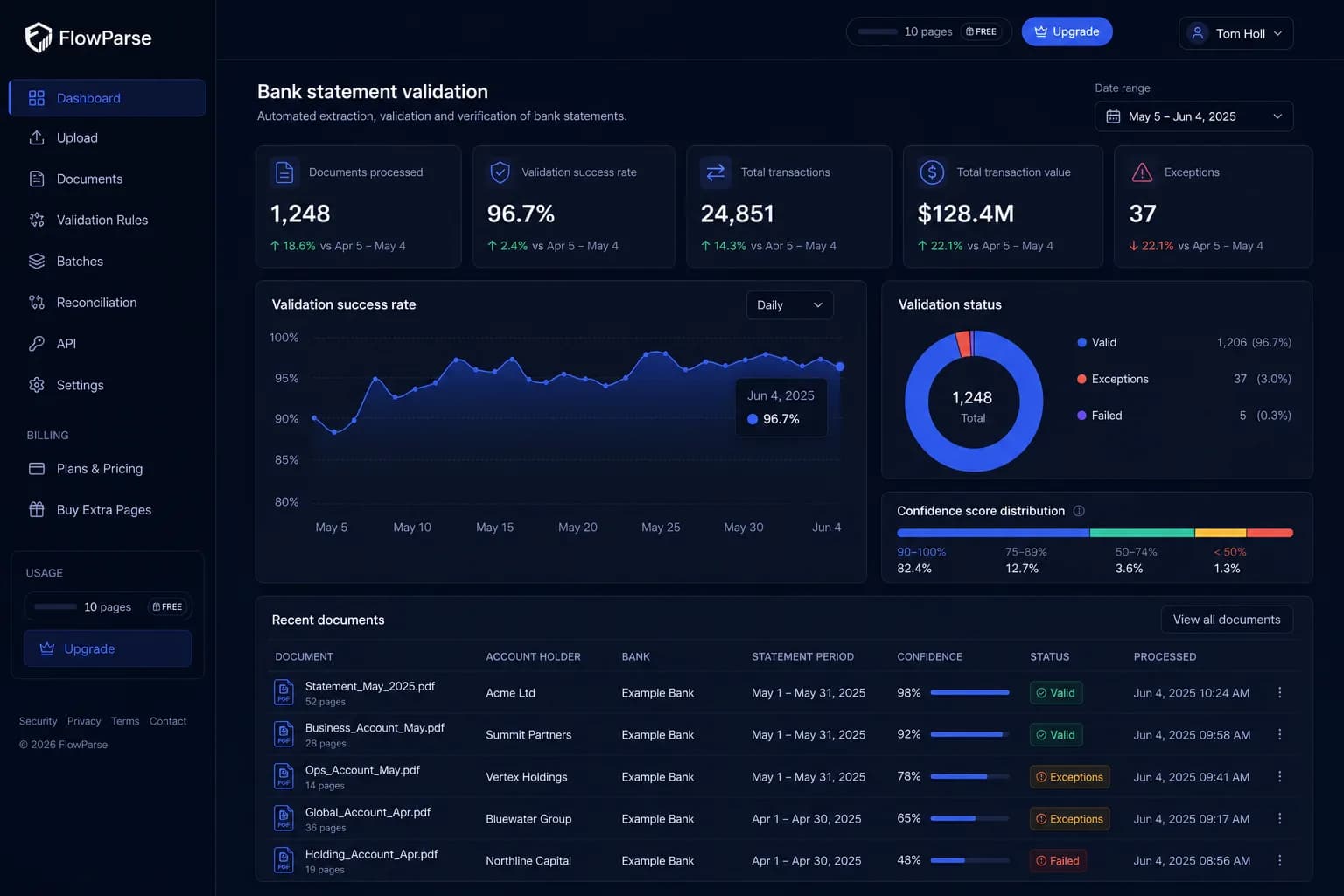
Hyperscience is an enterprise document-processing platform built for high-volume operations: mixed mail streams, handwriting, human-in-the-loop at scale, and deployment options that include running inside your own environment. FlowParse is a hosted, finished financial tool — validated transactions, a balance check and native QBO/QFX/OFX/Xero export, self-serve, free to start.
Enterprises and public bodies processing very high volumes of mixed, often handwritten documents — especially those who must run the system inside their own environment.
Teams whose documents are financial and who want validated, importable data now — hosted, self-serve, priced per page, with no implementation and no deployment project.
Why Businesses Look for Hyperscience Alternatives
Nothing to deploy
No installation, no environment, no rollout. Upload a statement and it works.
Balance validation in the box
Opening + transactions = closing, checked arithmetically, with a 0-100 quality score.
Accounting-ready export
Native .QBO/.QFX/.OFX and Xero/Excel files, not fields you map into a ledger yourself.
Priced per page, not per programme
A free monthly allowance and a per-page balance — no minimum, no annual commitment.
Consolidation built in
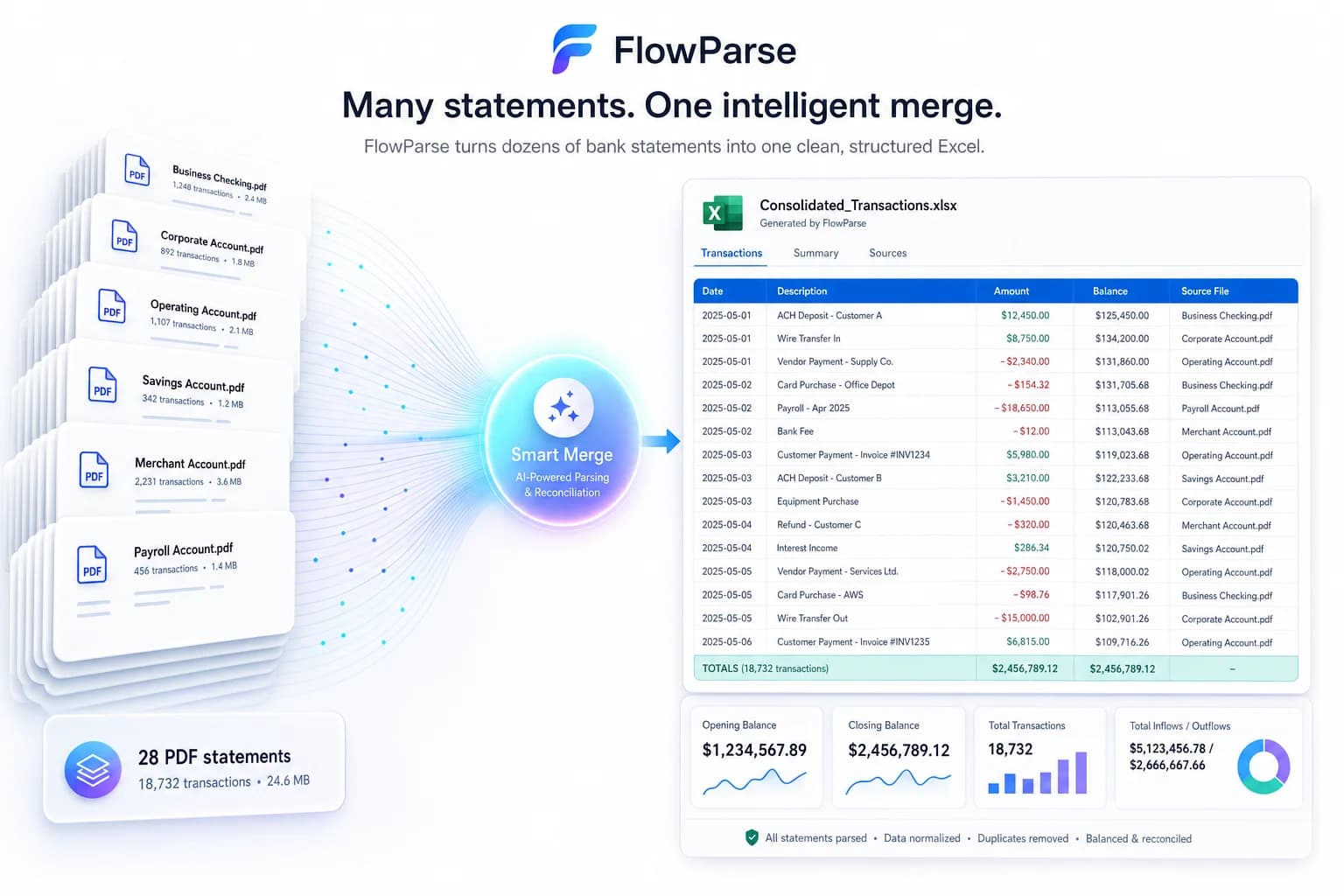
Smart Merge turns a year of PDFs into one reconciled Excel — already built.
Usable in five minutes
No sales call, no signup to try, no onboarding. Convert a real statement now.
Quick Comparison — Hyperscience vs FlowParse
A feature-by-feature look at Hyperscience and FlowParse.
| Feature | Hyperscience | FlowParse |
|---|---|---|
| Bank statement PDF → structured transactions | Configure the platform | Yes |
| Time to first result | An implementation | Minutes |
| Debit/credit → single signed amount | Configure it | Yes |
| Balance reconciliation + quality score | Build the rule | Yes |
| Native .QBO / .QFX / .OFX export | Build the integration | Yes |
| Xero / Excel / CSV export | Build the integration | Yes |
| Smart Merge — 100 PDFs → 1 Excel | Build the workflow | Yes |
| On-premise / private deployment | Yes | No |
| Handwriting at volume | Yes | Printed/scanned financial docs |
| Self-serve signup, no sales call | No | Yes |
| Free tier | No | Free pages/month + no-signup try |
| REST API | Yes | Yes |
What Is Hyperscience?
Hyperscience is an enterprise platform built for document operations at a scale most companies never encounter: mailrooms receiving hundreds of thousands of pages, mixed batches where nobody knows what the next page is, forms filled in by hand, and processes where a human has to be in the loop on the uncertain ones without becoming the bottleneck. It is strong on exactly the material that defeats ordinary extraction — handwriting, poor scans, unclassified batches — and it is built to be deployed in demanding environments, including inside an organisation's own infrastructure. For a government agency, an insurer or a bank with that shape of problem, that is a serious and well-matched tool.
The cost of that capability is that it is a programme. The platform is procured, deployed, configured to your document types and processes, integrated with your systems, and operated by people whose job that is. Entirely proportionate when you are automating a mailroom that employs forty people. Wildly disproportionate when what you need is a year of bank statements turned into Excel, or statement import shipped in your product this sprint.
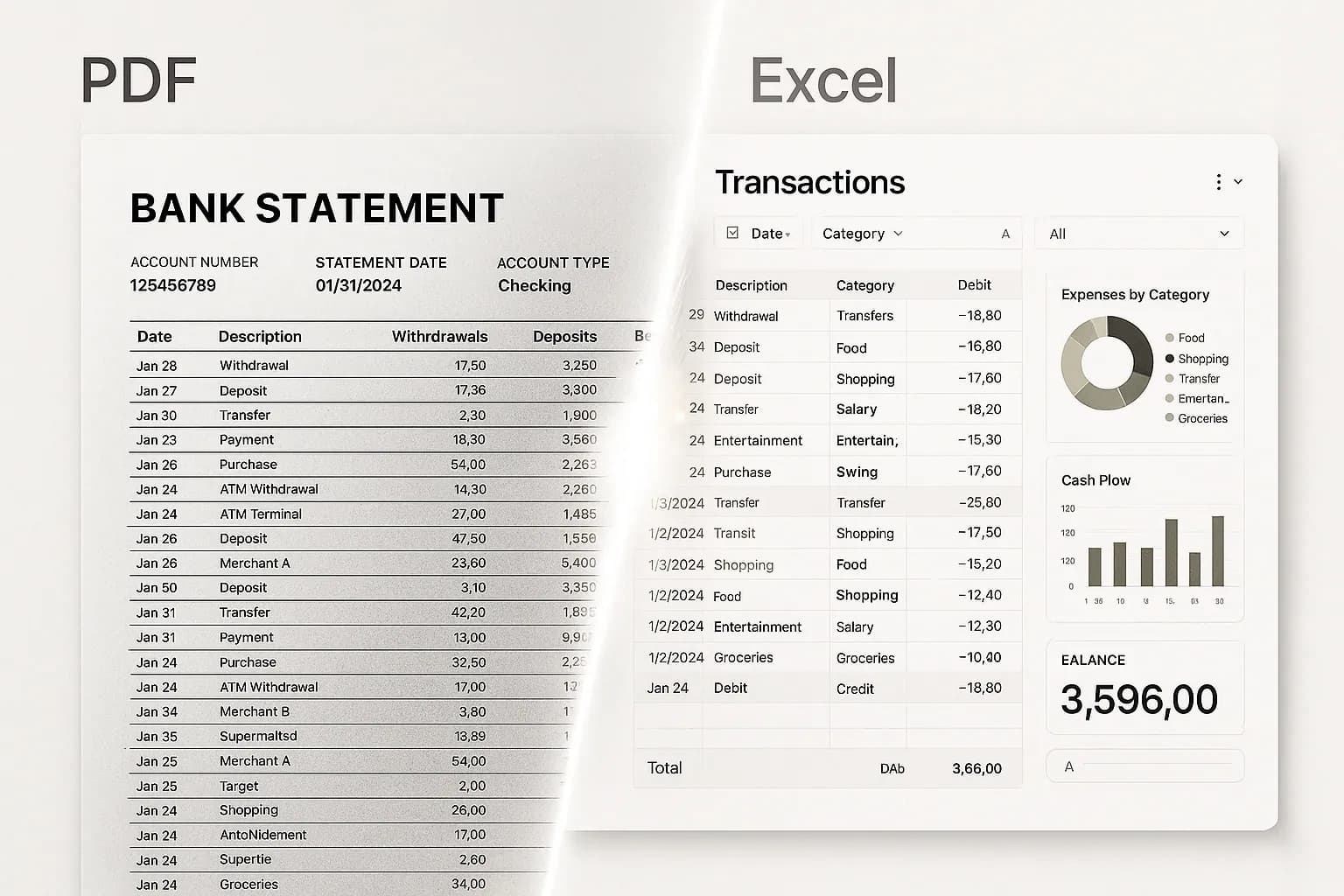
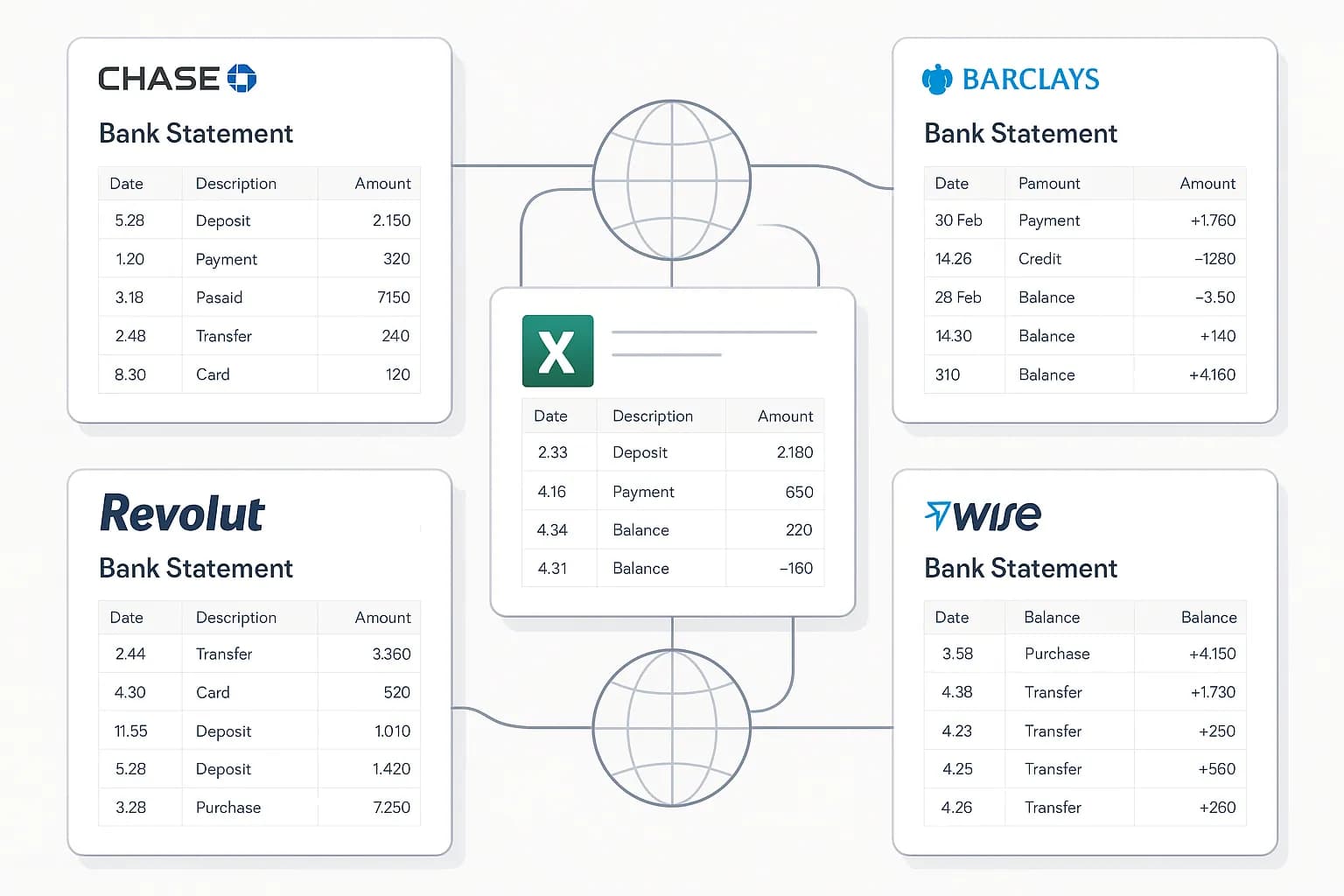
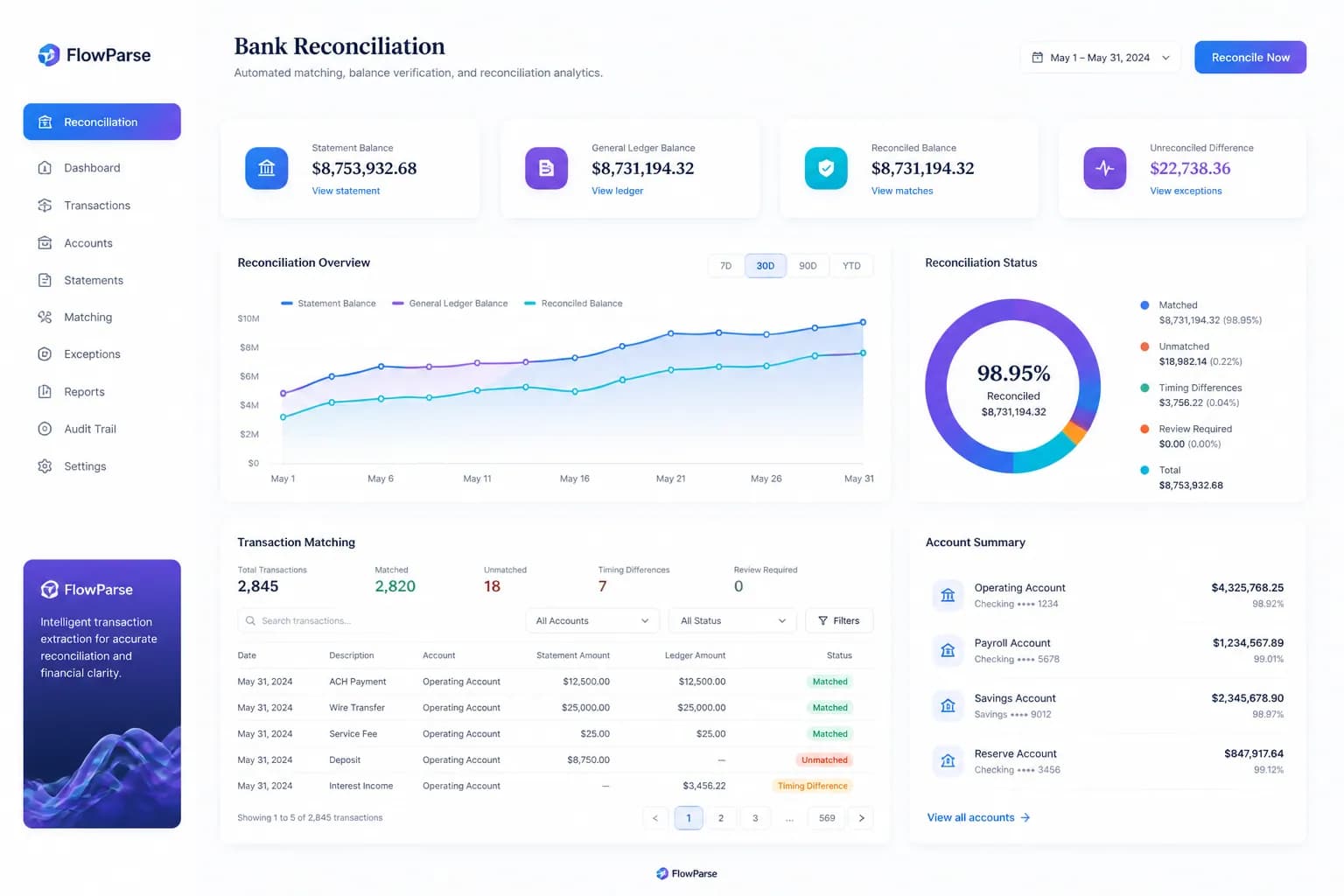
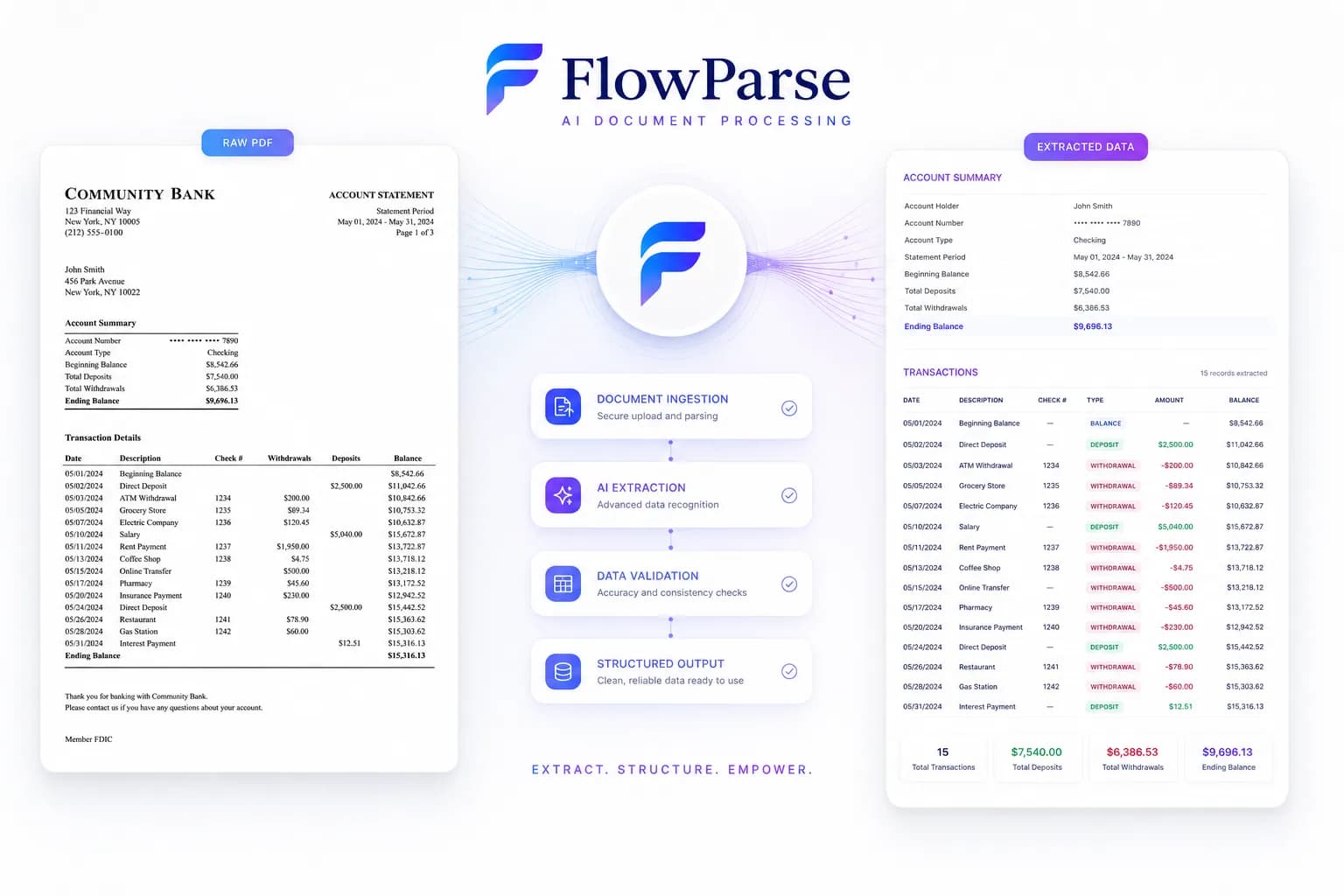
FlowParse is deliberately the other end of that spectrum. It is pre-trained on [bank statements](/bank-statement-converter), [invoices](/invoice-parser) and [receipts](/receipt-scanner), with [balance validation](/features/validation-engine), an [editable review grid](/features/editable-preview), [Smart Merge](/merge-pdf-to-excel) and native [accounting export](/features/accounting-software-export) already built — because for financial documents those decisions have right answers that do not need configuring. You upload a statement, you get validated data, and there is nothing to deploy. It is hosted, and only hosted: that is a real constraint, and this page says so plainly rather than burying it.
Hyperscience strengths
- Exceptional on handwriting, poor scans and mixed, unclassified batches
- Built for very high volume with human-in-the-loop that scales
- Deployment options including running inside your own environment
- Enterprise governance, support and operational expectations
Where teams want something different
- A procurement, deployment and configuration programme, not a tool you try
- No pre-built accounting exports (QBO/QFX/OFX/Xero) — you integrate
- No self-serve signup or free tier to evaluate on a real document
- Disproportionate when the need is one document family, done well
Why Teams Switch to FlowParse
Skip the deployment
Nothing to install or configure — financial documents are pre-trained and finished.
Start free, today
Convert a real statement with no sales call, no signup, no procurement.
Statements to a real bank feed
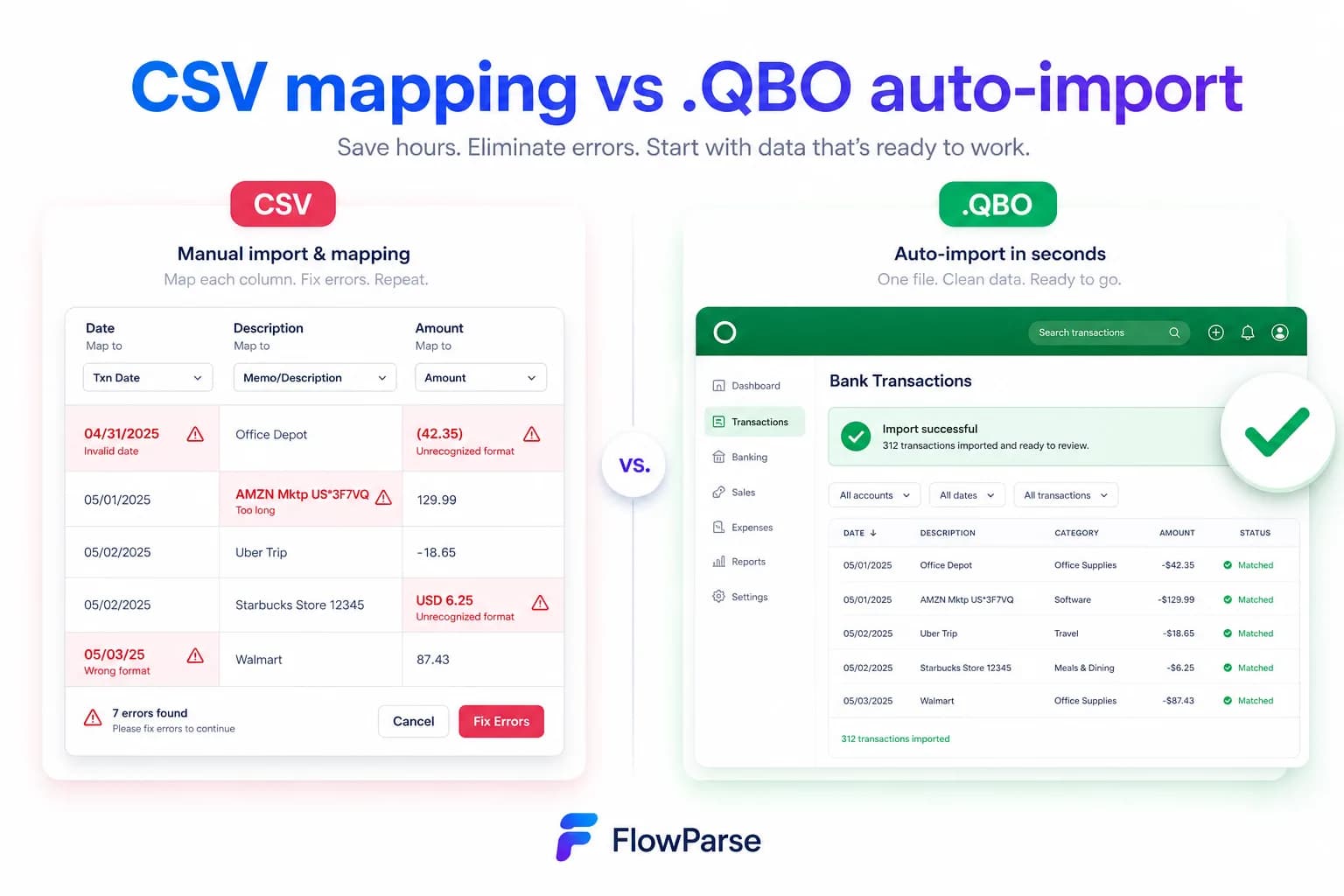
Export .QBO/.QFX/.OFX (OFX 1.0.2, FITID de-dup) so imports never double-post.
A quality gate you can trust
Balance reconciliation, duplicate detection and a 0-100 score ship in the box.
Priced per page
No minimum and no annual commitment — pay for the pages you actually convert.
Consolidate a year at once
Smart Merge combines up to 100 statements into one reconciled Excel.
An enterprise programme vs a finished tool
Hyperscience industrialises document operations at scale. FlowParse finishes one document family and hands it to you.
Hyperscience path
- Procurement and scoping
- Deploy the platform
- Configure document types
- Design review + integrations
- Operate and maintain it
FlowParse path
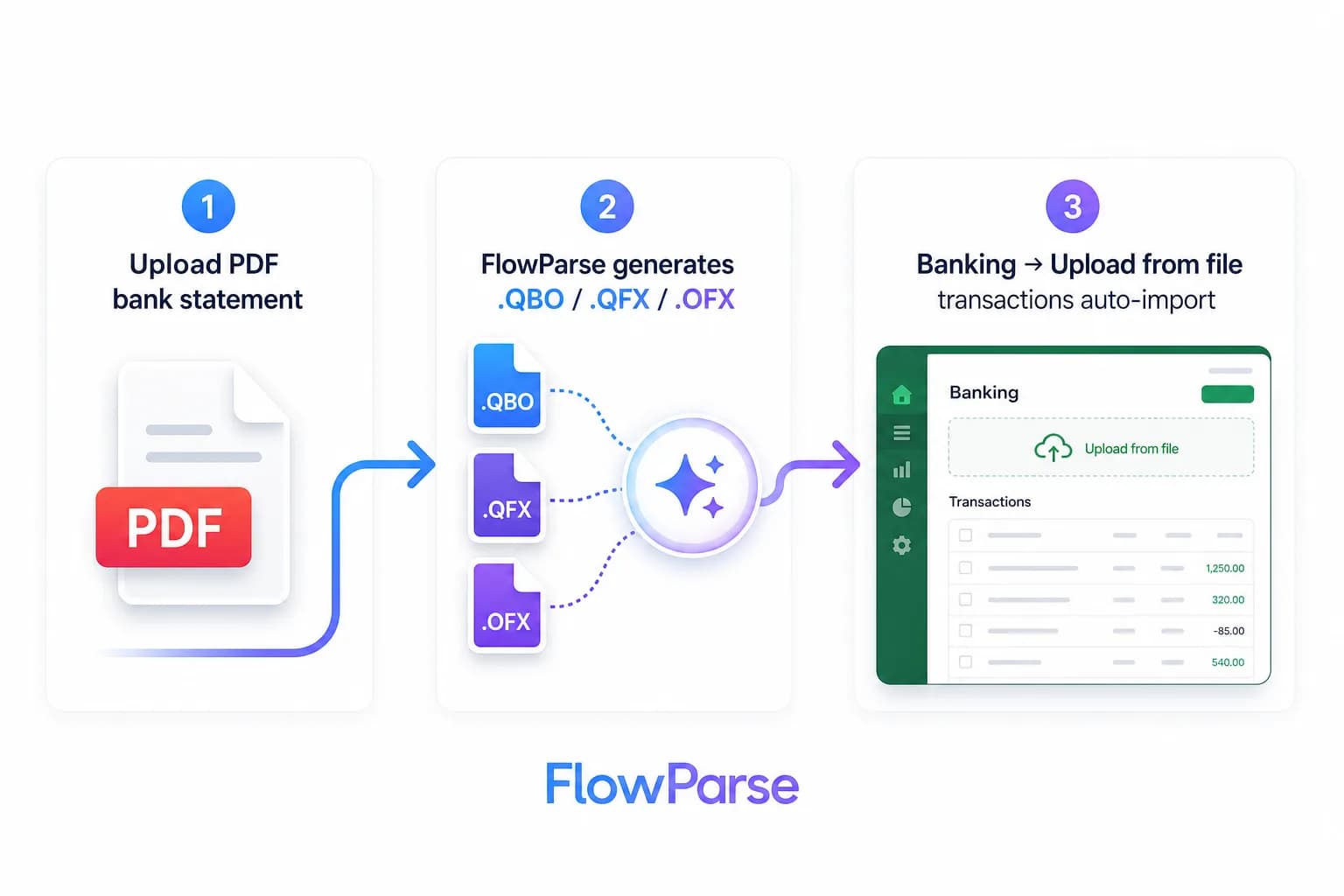
- Upload a statement, or call the API
- Validated, signed transactions
- Balance check + editable review built in
- Smart Merge to consolidate
- Export native QBO/QFX/OFX/Xero/Excel
Pricing Comparison
How the cost and commitment models compare.
| Feature | Hyperscience | FlowParse |
|---|---|---|
| Free tier | No (enterprise sales) | Free pages/month + no-signup try |
| Model | Enterprise contract | Per page from a balance |
| Minimum commitment | Typically annual | None |
| Deployment cost | A programme | None (hosted) |
| Accounting-export files | Build the integration | Yes (QBO/QFX/OFX/Xero) |
| Setup to first result | An implementation | None (app) / one call (API) |
Accuracy Comparison
Both platforms use modern AI OCR — here is how extraction quality is assured.
| Feature | Hyperscience | FlowParse |
|---|---|---|
| Handwriting | Excellent | Not the target |
| Mixed, unclassified batches | Excellent | Financial documents |
| Bank statement transactions | Configure the platform | Every row, balance-validated |
| Debit/credit normalisation | Configure it | Single signed amount |
| Balance reconciliation | Build the rule | Built in |
| Human review step | Yes (at scale) | Editable grid + API |
Who should choose Hyperscience?
- Enterprises and agencies with very high-volume document operations
- Organisations processing handwriting and mixed mail streams
- Teams that must run the system inside their own environment
- Operations with staff dedicated to running the platform
Who should choose FlowParse?
- Accountants and finance teams converting statements and invoices
- Developers wanting validated financial data plus export from one call
- Teams with no appetite for a deployment or procurement project
- Anyone wanting a free, self-serve way to convert a document today
Migrating from Hyperscience to FlowParse
Switching takes minutes — there are no templates to rebuild or models to retrain.
Export your documents
Export invoices and statements from Hyperscience or your source.
Upload to FlowParse
Drag and drop PDFs, scans, or images — no setup.
Review extracted data
Check fields in the editable preview before export.
Export Excel or CSV
Download structured data for your accounting system.
Automate workflows
Use the API and integrations for future documents.
Hyperscience vs FlowParse: industrial operations vs a finished tool
These two are not really rivals, and the useful thing this page can do is say why. Hyperscience is built for document operations as an industrial process: volume measured in hundreds of thousands of pages, batches nobody has sorted, forms filled in by hand, and a workforce of reviewers who need work routed to them intelligently rather than drowning in it. Everything about the platform follows from that — the classification, the human-in-the-loop design, the deployment options, the enterprise governance. If that is your problem, this is a market with few serious entrants and Hyperscience is one of them.
FlowParse is built for a completely different scale of pain: one accountant, one developer, one finance team, and a stack of financial PDFs that need to become correct numbers in a ledger. It is pre-trained on that family and finished for it — validation, review, consolidation, accounting export — and it is hosted, self-serve and metered per page.
So the choice is rarely close, in either direction. Mailroom, handwriting, mixed batches, on-premise mandate, dedicated operations staff? Hyperscience, and this page is not trying to talk you out of it. Bank statements and invoices that must be validated and importable, wanted this afternoon, by someone with no project budget? A finished tool is the right shape, and a platform would spend its first month before reading a page.
What we do not offer, plainly
Most comparison pages bury the competitor's advantages. Here are Hyperscience's, stated first. It runs inside your own environment if you need it to — we do not offer on-premise or private-cloud deployment at all, and no amount of talking about EU processing changes that. It reads handwriting well; we target printed and scanned financial documents and would be the wrong tool for a stack of handwritten forms. It classifies mixed batches where the next page could be anything; we expect financial documents. It routes review work across teams of human operators at industrial volume; our review is one person checking flagged rows in a grid.
If any of those is a requirement rather than a nice-to-have, the honest recommendation is Hyperscience, and we would rather you learn that here than after a security review or a failed pilot.
What we do offer is the opposite trade taken seriously: for financial documents specifically, everything is already decided and already built, it costs pennies per page, and you can prove it works on your own statement in the next two minutes without asking anyone's permission.

The layers a platform asks you to configure
On a general platform, the financial specifics are yours to encode. Merging separate debit and credit columns into a single signed amount is a rule someone writes — and getting the sign wrong is the most consequential bug in this domain, because the total still looks like a number. Confirming that opening balance plus every transaction equals the closing balance is a validation someone has to think of, author and maintain. Consolidating twelve statements without duplicating the overlapping month is a workflow. Producing a `.QBO` file with a stable `FITID` per row is an integration.
In FlowParse all four ship in the box, because they are not variations between customers — they are what the financial job is. That is the compensation for refusing to be general: the specifics are the product rather than a configuration surface.
| Layer | Hyperscience | FlowParse |
|---|---|---|
| Read a bank statement | Configure the platform | Pre-trained |
| Debit/credit → signed amount | Configure it | Built in |
| Balance validation + score | Author the rule | Built in |
| Consolidate many statements | Build the workflow | Smart Merge |
| .QBO/.QFX/.OFX/Xero files | Build the integration | Native |
| On-premise deployment | Available | Not offered |
The check that comes from knowing the document
There is one advantage a specialist has that no general platform can match without becoming a specialist: it knows what the document claims about itself. A bank statement prints its own closing balance, which means it carries a testable assertion — opening balance, plus every transaction, must equal that figure.
FlowParse runs that check on every statement, and it is the only test that can prove an extraction wrong with no labelled data and no human in the loop. A dropped row has no confidence score to be low; it simply is not there, and everything else looks perfect. Arithmetic catches what a model's self-assessment cannot.
On a platform, that check is possible — someone has to know statements well enough to think of it, then author it, then maintain it. Validation here returns a 0-100 score with the offending rows named, because the whole product is pointed at one family of documents and can afford to know them that well.

The accounting export gap
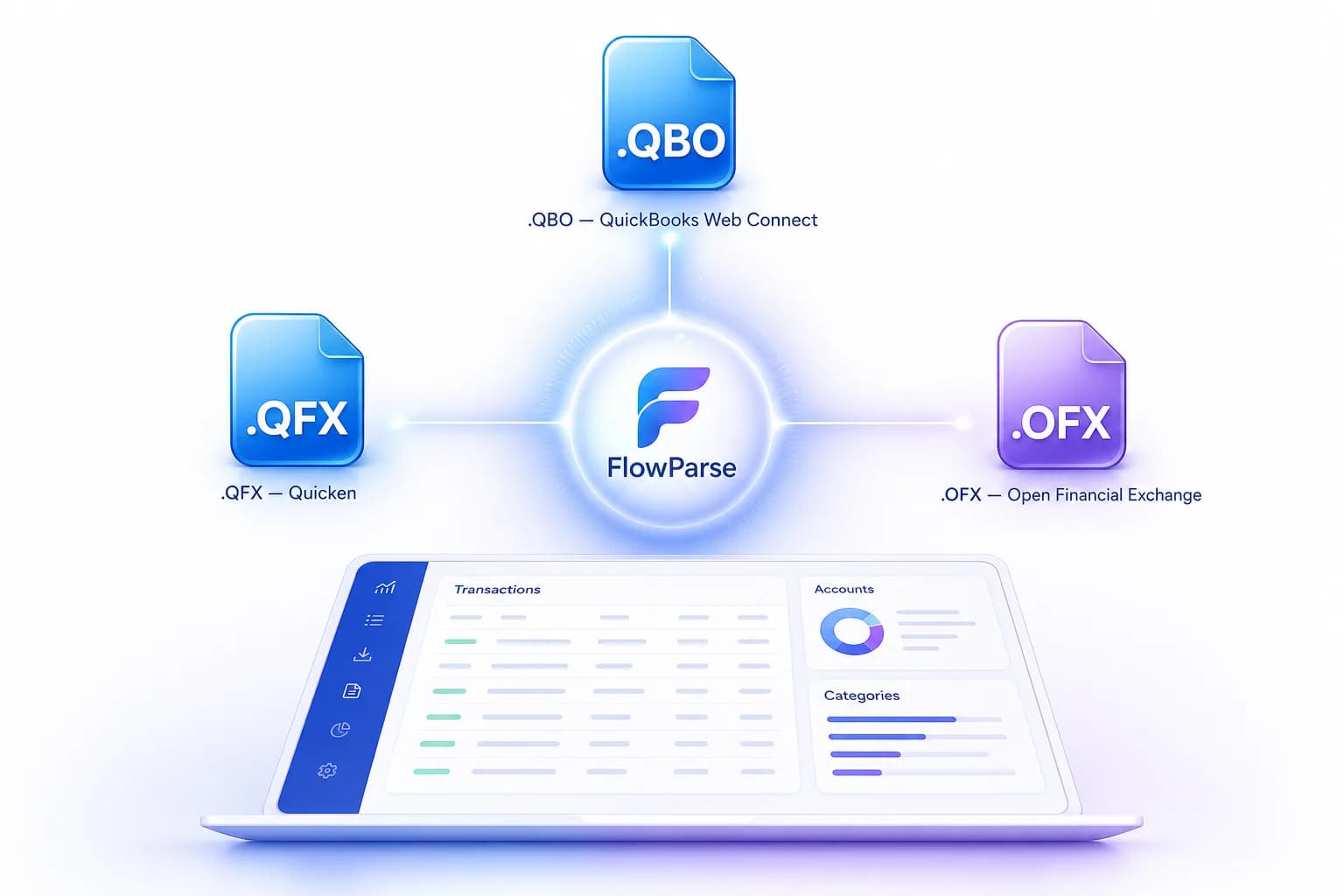
General platforms rarely ship the financial last mile, because it is specific to a destination they cannot assume. FlowParse produces real Open Financial Exchange files out of the box: `.QBO` and `.QFX` for QuickBooks and Quicken, `.OFX` for tools like GnuCash and Sage, plus a Xero-ready CSV and clean Excel. Each transaction carries a stable `FITID`, which is what stops a re-import double-posting rows the user already has.
That is an integration you neither scope nor maintain. The accounting export feature and the PDF to QBO page list every format and the exact import steps into each tool.
Priced per page, and free to prove
Enterprise platforms are bought, not tried, and that is not a criticism — the value is large and the deployment is real work. But it means the tool is unreachable for the bookkeeper with a year of PDFs, the accountant onboarding a client, and the developer who wants to know if this works before writing a business case.
FlowParse is per page from a top-up balance, with a free monthly allowance and no signup required to try it. No minimum, no commitment, no call. See the pricing page; usage is visible per API key, so cost stays predictable and attributable.
Try it on the specific, awkward statement your bank actually produces — that is the only test that means anything, and no demo answers it.
One engine for statements, invoices and receipts
Being narrow does not mean handling one document. FlowParse extracts bank statements, invoices and receipts with full line items, supplier and buyer details, totals and a tax breakdown, and runs an AI VAT auditor on invoices — all on the same pre-trained engine, in a consistent schema.
Because everything comes back in the same shape, cross-document workflows are built in rather than configured: an invoice you extracted can be reconciled against the bank payment you extracted from a statement, with no mapping between separate processes. The financial estate — and the reconciliation between its parts — is the whole scope, and it is already assembled.
Where Hyperscience genuinely wins
Restating it, because it deserves more than a footnote. If your documents are handwritten, Hyperscience is built for that and we are not. If your batches arrive unsorted and unclassified, Hyperscience is built for that and we expect to be handed a financial document. If your volume is industrial and your review capacity is a team of people who need work routed to them intelligently, that is precisely the product. And if your organisation requires the system to run inside its own infrastructure, that requirement alone decides it: we are hosted only.
There is also the matter of what an enterprise buys alongside software — governance, audit, access control, support arrangements, a deployment story that survives a security review at a regulated institution. Those are table stakes for Hyperscience's market and they are not things a self-serve tool competes on.
The division is by scale and by constraint, not by quality. Industrial volume, handwriting, mixed mail, on-premise mandate? Hyperscience. Financial documents that must be validated, provably complete and importable into QuickBooks or Xero — used today, by someone with no project? FlowParse. An enterprise can honestly run both: the platform for its operations, a specialist for the financial documents where the accounting export is the point.
Total cost of ownership, not just licence price
For an enterprise platform, the licence is rarely the biggest number. Deployment, configuration, integration, the operators who run it, and the maintenance as document types drift are the real total — and when it industrialises a mailroom that employed forty people, that total is easily justified. The economics work at that scale, which is exactly why the market exists.
The mismatch appears when the same shape is applied to one document family. Then you are funding a general capability, a deployment and a configuration effort to obtain what a specialist already ships: validated transactions, consolidation and accounting export. FlowParse's total cost of ownership sits close to its per-page price because the engine is pre-trained, the workflow is finished and non-developers use it without any UI work.
So the test is simple and honest. Industrial volume, handwriting, or a deployment mandate? Buy the platform. Financial documents that need to be right and importable, wanted today? A finished tool gets you there this afternoon, at a price that is a line on a usage report rather than a programme.